Water Intrusion in a Home Inspection: How to Find the Source and Know Who to Call
Water is the most costly threat to your home. Discover how to identify water intrusion sources during an inspection and who to call for help.
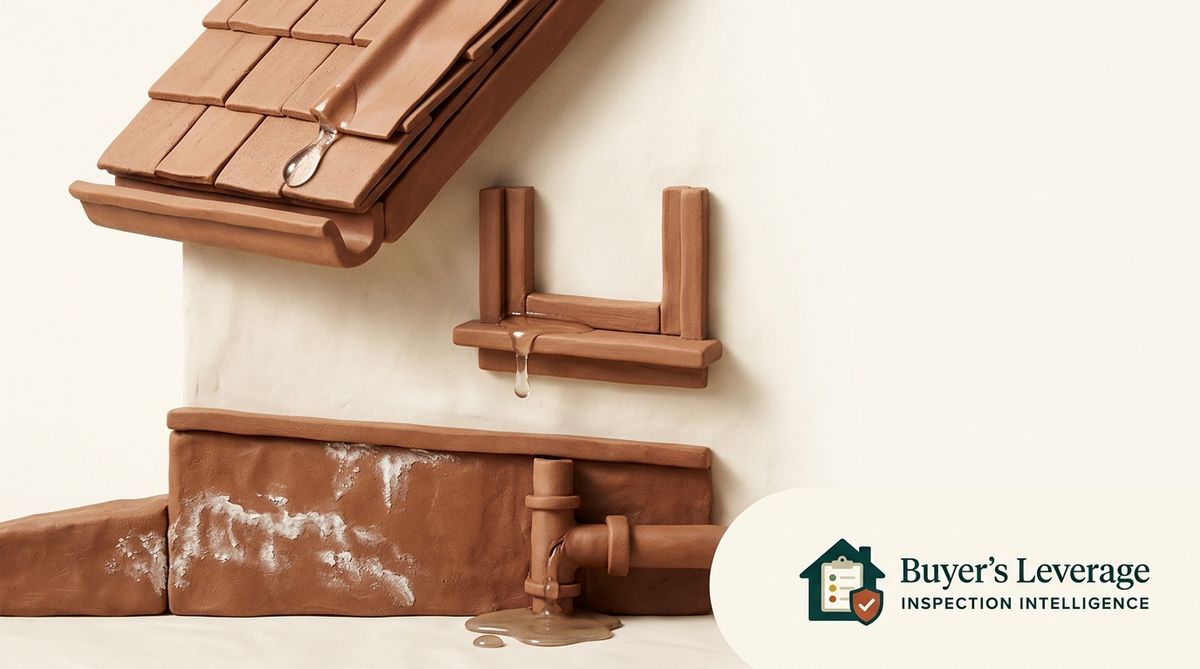
Water is the single most expensive long-term threat to a house. Your inspection flagged moisture evidence — staining, efflorescence, damp materials — and now you need to figure out where it's coming from and whether it's still happening.
Why Water Intrusion Findings Hit Differently
Water doesn't just stain surfaces. It rots wood, rusts metal, feeds mold, and undermines foundations. A single chronic leak can cost more over five years than every other inspection item combined.
That's why your inspector calls it out even when the wood is dry at the moment of the inspection. They're documenting evidence of past events — and trying to help you figure out if those events are still happening.
The good news: most water intrusion has a fixable, low-cost source. The hard part is figuring out which of the six common entry points is yours.
Active vs. Old: Reading the Evidence
Your report will often distinguish between current moisture and historical staining. Here's how to tell the difference.
Active moisture means the inspector's moisture meter registered elevated readings in wood, drywall, or concrete right now. You'll see phrases like 'moisture present', 'damp to the touch', 'elevated meter reading', or 'active seepage'.
Old staining shows up as discoloration, mineral deposits (efflorescence — white chalky powder on concrete or brick), or waterlines on wood. The material is dry now, but something happened in the past.
Both matter. Active moisture tells you the problem is current. Old staining tells you the house has a history — and you need to ask the seller what was done about it.
The Six Common Water Intrusion Sources (In Frequency Order)
Most moisture findings trace back to one of these six entry points. Understanding the list helps you skip expensive specialists when a simpler fix is the real culprit.
1. Gutters and downspouts (most common). Clogged, undersized, or poorly routed gutters dump thousands of gallons against the foundation every year. You'll see staining in crawlspaces, basements, or on exterior foundation walls near downspout discharge points.
2. Grading and surface drainage. If soil slopes toward the house instead of away, every rainstorm sends water straight to the foundation. Look for staining on the lower portion of foundation walls or crawlspace moisture near exterior walls.
3. Roof issues (flashing, missing shingles, worn valleys). Water enters at roof penetrations (chimneys, vents, skylights) or damaged shingle zones, then travels along rafters or inside walls before showing up as ceiling stains or attic moisture.
4. Window and door flashing. Improperly sealed or missing flashing around windows and doors lets wind-driven rain enter wall cavities. You'll see staining on interior drywall near window frames or below sills.
5. Plumbing leaks (supply lines, waste lines, fixtures). These show up as localized staining near bathrooms, kitchens, or utility rooms. Often accompanied by soft subfloors or cabinet-bottom damage.
6. Foundation cracks and seepage. True foundation water intrusion — hydrostatic pressure pushing groundwater through cracks or porous concrete — is less common than most people think, but when it's the source, it's often chronic and needs engineered solutions.
How to Attribute the Source (What Your Inspector Saw)
Your inspector documented where they found moisture, which is half the puzzle. Now you connect that location to a likely source.
Crawlspace moisture near exterior walls, especially after recent rain? Start with gutters and grading. Walk the perimeter. Are downspouts dumping next to the foundation? Does soil slope toward the house?
Attic staining on rafters near roof penetrations or along one roof plane? Roof issue. Look at the exterior directly above the stain.
Basement corner dampness or efflorescence on foundation walls? Could be grading, could be a gutter downspout terminating too close, or could be a foundation crack. Check outside first — it's usually cheaper.
Staining on drywall near windows or doors? Flashing issue. These often show up during wind-driven rain, not gentle showers.
Isolated moisture under a bathroom or kitchen? Plumbing leak. Your inspector may have noted soft flooring or visible supply-line corrosion.
Your inspector's photos are important here. Zoom in. Look at the staining pattern. Linear stains running down a wall suggest a point source above. Broad dampness at floor level suggests surface water entering from outside.
Efflorescence: The White Chalky Stuff on Concrete
If your report mentions efflorescence, you're looking at mineral deposits left behind when water evaporates out of concrete or masonry. It looks like white powder, crystalline deposits, or chalky streaks.
Efflorescence itself isn't the problem — it's the evidence. It tells you water moved through the material at some point, carrying dissolved salts to the surface.
The question is when. Efflorescence can sit on a foundation wall for years after a one-time grading fix or gutter repair. If the concrete is dry now and the seller says they regraded two years ago, that may be old evidence of a solved problem.
If the efflorescence is fresh (bright white, fluffy texture, and the concrete is damp), the water movement is ongoing. That's when you dig deeper.
Who to Call First (and How to Avoid Expensive Rabbit Holes)
This is where buyers waste money. They see foundation moisture, panic, and call a foundation-repair company — who finds $12,000 of work to do, when the real problem was a $200 downspout extension.
Start with the simplest, cheapest likely source. If the moisture is in a basement or crawlspace near exterior walls, start outside. Hire a handyperson or gutter company to check grading and downspouts. Ask them to watch the house during a rainstorm if possible.
If grading and gutters check out, move to the roof. A roofer can inspect flashing, shingles, and valleys for a few hundred dollars. If they find nothing, then you escalate.
If it's truly a foundation issue — widespread seepage, cracks with active water entry, or a high water table problem — then you call a foundation specialist or structural engineer.
For plumbing, call a plumber. Moisture under a bathroom is almost rarely a foundation problem.
The order matters. Inspecting from cheap-to-expensive saves you thousands and gets you to the real fix faster.
What 'Recommend Further Evaluation' Really Means
Inspectors use this phrase when they've found evidence but can't open walls, dig around foundations, or disassemble roofing to confirm the exact source and scope.
It's not a punt. It's professional humility. Your inspector is saying: 'I see moisture here, I see staining there, and based on location I suspect X — but you need someone with specialized tools (infrared camera, moisture mapping, excavation access) to confirm and price the fix.'
Treat it as a roadmap, not a red flag. The inspector is handing you a starting point and telling you which specialist to call. Use the attribution steps above to narrow it down before you spend money on evaluations.
How to Use Seller Disclosure and Repair History
If your report shows old staining or efflorescence, the seller's disclosure becomes important. Did they note prior water intrusion? Did they fix grading, replace gutters, or repair a roof in the past three years?
If the disclosure says 'regraded and installed downspout extensions in 2022' and your inspector found only old efflorescence (dry now), that's a very different picture than active moisture with no disclosure.
Ask your agent to request copies of any invoices or permits for water-related repairs. A $3,000 gutter-and-grading invoice from 18 months ago, combined with no new moisture, is good evidence the problem was addressed.
If the seller says 'we rarely had water problems' and you're looking at widespread staining, you have a credibility issue and a negotiation data point.
Moisture in Crawlspaces: The Special Case
Crawlspaces are ground-level, often dirt-floored, and naturally damp in many climates. Your inspector is looking for intrusion moisture (from gutters, grading, or foundation cracks) vs. ambient moisture (normal ground vapor).
Signs of intrusion: staining on foundation walls, standing water near exterior walls, moisture concentrated on one side of the crawlspace, or damp insulation above wet areas.
Signs of ambient moisture: even dampness across the dirt floor, no staining, no localized pooling. This is often addressed with vapor barriers, venting adjustments, or dehumidification — not foundation repair.
Your inspector's call on whether a crawlspace needs a vapor barrier, better venting, or exterior drainage work will be based on moisture patterns. If they flag 'recommend vapor barrier and monitor', that's a maintenance item. If they flag 'standing water near northeast corner, suspect exterior drainage issue', that's a source-attribution problem.
When to Walk Away vs. When to Negotiate
Not all water intrusion is a deal-killer. A missing downspout extension and some old basement staining is a negotiation item. Chronic foundation seepage across multiple walls, active mold growth, and rotted floor joists is a different conversation.
Here's a mental framework. If the source is identifiable and the fix is known, you're in negotiation territory. Gutters, grading, roof flashing, plumbing leaks — all fixable, all priceable.
If the source is unclear, widespread, or structural, and you're looking at potential mold remediation, joist replacement, or foundation underpinning, get a specialist evaluation before you decide. Some of those scenarios are fixable; some aren't worth the risk unless you're getting a steep discount and have contractor experience.
Your agent and your specialist evaluations will guide this decision. Don't make it alone based on the inspection report — the report is the starting gun, not the finish line.
Using Buyer's Leverage's [Water Intrusion Risk Checker](/tools/water-intrusion-risk-checker)
If you're staring at your report right now trying to figure out whether 'efflorescence on north foundation wall' is a $200 fix or a $10,000 problem, Buyer's Leverage's water intrusion risk checker can help.
You'll answer a few questions about what your inspector found, where they found it, and whether it's active or old. The tool walks you through source attribution and suggests which specialist to call first — and gives you a rough planning range for what the fix might cost if it's the common scenario.
It won't replace a contractor bid, but it'll keep you from calling a foundation company when you need a gutter cleaner. That alone saves most buyers a week and a few hundred dollars in unnecessary evaluations.
What Happens Next: Building Your Follow-Up Plan
Here's the calm next-step sequence.
Step 1: Read your inspector's narrative and look at every photo. Note the location, the evidence type (active moisture, old staining, efflorescence), and any explicit recommendations.
Step 2: Walk the property exterior if you can. Look at gutters, downspouts, grading, and roof condition from the ground. Take your own photos.
Step 3: Use the attribution logic above to form a hypothesis about the source. Write it down: 'I think this is a grading issue because the moisture is in the crawlspace near the back wall and the soil slopes toward the house.'
Step 4: Call the simplest specialist first. If you think it's gutters, call a gutter company. If you think it's roof, call a roofer. Ask them to evaluate and give you a written scope and estimate.
Step 5: Share that scope and estimate with your agent. Discuss whether you're asking the seller to fix it, asking for a credit, or negotiating a price reduction. Use the estimate as a data point, not a demand.
This is a process, not a crisis. Take it one step at a time.
Real-world scenario
You just got your inspection report and it says 'efflorescence on north foundation wall, moisture meter readings elevated in adjacent crawlspace framing, recommend further evaluation.' You're panicking. Here's what you do. First, look at the inspector's photos — where exactly is the staining, and is it localized or widespread? Then walk the outside of the house on the north side. You notice the downspout from the back gutter dumps right next to the foundation, and the soil slopes slightly toward the house. You call a local gutter-and-drainage company, show them the report, and ask for an evaluation. They come out, quote $1,800 to extend the downspout with an underground drain line and regrade a 20-foot section. You send that estimate to your agent, who asks the seller for a $2,000 credit at closing. Seller agrees. You close, hire the company, problem solved. Total time from panic to resolution: nine days.
Water Intrusion Severity Screener
Answer a few questions about what your inspector found to gauge next steps
Still in your inspection window?
Upload your report now to get a prioritized issue list, planning ranges, and negotiation talking points before your contingency expires.
- Water Intrusion in a Home InspectionOffers detailed background on water intrusion issues
- Basement Water Intrusion Home InspectionFocuses on basement-specific water intrusion signs
- What to Negotiate After a Home InspectionGuides readers on negotiation steps post-inspection
- Repair Exposure CalculatorHelps estimate costs of fixing water intrusion damage
- Water Intrusion Risk CheckerAllows users to assess water intrusion risks quickly
- Foundation Cracks Found in InspectionDetails potential foundation issues linked to water
- Your Inspection Contingency WindowHelps manage timelines for inspection-related decisions
Frequently asked
What does water intrusion mean in a home inspection?+
Water intrusion means moisture is getting into the house where it shouldn't—through the roof, windows, foundation, or plumbing. Your inspector flags it because ongoing moisture causes mold, rot, and structural damage over time.
Is water intrusion a deal breaker when buying a house?+
Not often. Active leaks and widespread damage are serious, but isolated stains or minor basement seepage may be fixable. Talk to your agent about getting a specialist to scope the issue and estimate repairs before you decide.
How do inspectors find water intrusion during a home inspection?+
They look for visible signs—stains, soft spots, peeling paint, mold, musty odors. Many use moisture meters to check hidden areas. If they find something suspicious, they'll often recommend a specialist with infrared cameras or other diagnostic tools.
What's the difference between active and old water intrusion?+
Active intrusion means water is still getting in—you'll see wet materials, fresh stains, or high moisture-meter readings. Old intrusion shows up as dried stains or past damage. Both matter, but active leaks need faster attention.
Who should I call to fix water intrusion found in an inspection?+
It depends on the source. Roof leaks need a roofer. Foundation or grading issues need a foundation specialist or drainage contractor. Plumbing leaks need a plumber. Your inspector's report usually points you in the right direction.
Can I negotiate repairs for water intrusion before closing?+
Often, yes. Buyers commonly ask sellers to fix the issue, offer a credit, or reduce the price. Your agent can help frame the request based on repair estimates. Document everything and involve your lender if needed.
How much does it cost to fix water intrusion in a house?+
It varies widely. A small roof patch might run a few hundred dollars. Foundation waterproofing or extensive mold remediation can reach several thousand. Get quotes from licensed pros before you negotiate or budget.
Should I get a moisture specialist after a home inspection flags water intrusion?+
If the inspector found widespread staining, mold, or can't pinpoint the source, a specialist is worth it. They use advanced tools and can give you a detailed scope and cost estimate—helpful for negotiating and planning.
Buyer's Leverage provides decision-support information, not legal, engineering, inspection, contractor, lender, insurance, or financial advice. Repair exposure ranges are planning estimates, not bids.