Your Inspection Contingency Window: A Day-by-Day Roadmap for Confident Decision-Making
Use your inspection contingency window wisely with a clear day-by-day plan to review reports, get bids, negotiate, and make confident decisions.
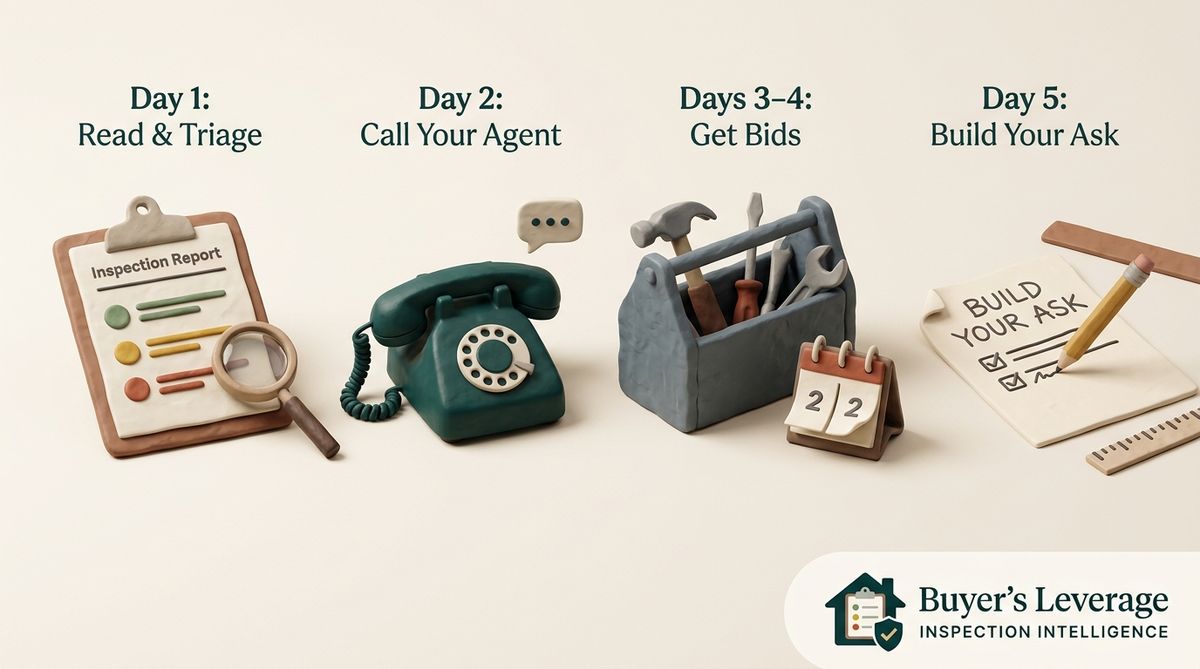
You've got seven to ten days to review the inspection report, decide what matters, get bids, negotiate with the seller, and either move forward or walk away. Here's how to use that time well without spinning your wheels.
Why the Inspection Contingency Deadline Matters More Than You Think
Your inspection contingency is a legal off-ramp. Until the deadline passes, you can cancel the contract and get your earnest money back if you're not satisfied with the condition of the home. Miss that date—even by a few hours—and in most states you're locked in.
The deadline also sets the pace for negotiation. Sellers know when your window closes, and they'll use that pressure to their advantage if you're scrambling on day nine. The goal is to front-load your work so you're negotiating from a calm, informed position by mid-week.
Most buyers spend the first three days in analysis paralysis, then panic-call contractors on day six. A better approach is to treat this like a short project with clear milestones. You don't need to fix everything—you need to understand what's important, get a few key bids, and decide whether to negotiate, accept, or walk.
Day 1: Read the Report and Identify Your Top Concerns
Your inspector just sent you a 60- or 80-page PDF. Don't try to memorize it. Start with the summary page—most reports call out the big items up front. Look for anything tagged 'safety concern,' 'recommend specialist evaluation,' or 'repair/replace.'
Make a short list of the three to five items that worry you most. This might be a roof with curling shingles, a furnace that's 22 years old, or a wet crawl space. These are the items you'll dig into over the next few days. Everything else can wait.
If you're using Buyer's Leverage, upload your report today. The platform flags the high-priority items and gives you plain-English context so you're not Googling 'what is a thermal cutoff' at midnight. Your agent should also walk you through the report on day one—if they haven't offered, ask.
Days 2-4: Get Specialist Bids on the Top Two or Three Items
This is the most important 72 hours of your contingency window. You need real numbers from licensed contractors—not guesses from your uncle or a forum thread. Focus on the items that either cost real money or affect safety: the roof, the HVAC system, foundation drainage, electrical panels.
Call two or three specialists per item. Explain you're under contract and need a written estimate by day four. Most contractors can visit within 48 hours if you're clear about the timeline. If they can't, move to the next name on the list.
Don't ask for full proposals with three options and financing—just a ballpark written estimate for the work the inspector flagged. You're not hiring anyone yet. You're building a fact base so you can negotiate or decide to walk. By the end of day four, you should have two or three written estimates in hand for the items that matter most.
Day 4-5: Draft Your Response to the Seller
Now you know what things cost. Sit down with your agent and draft a response. This is usually called an 'inspection objection' or 'repair request,' depending on your state. It's a formal document that lists the items you want the seller to address—either by fixing them, offering a credit, or reducing the price.
Be selective. Asking for 40 repairs makes you look unreasonable and gives the seller cover to say no to everything. Focus on the big-ticket items and anything that's a safety or code issue. Your agent will help you frame the request in a way that's firm but not combative.
Some buyers ask for a flat credit (say, $8,000 toward closing costs). Others ask for specific repairs. There's no one right answer—it depends on the market, the seller's situation, and what you're comfortable managing after closing. Draft the request by end of day five so you have time to negotiate before your deadline.
Days 5-7: Negotiate Back and Forth with the Seller
The seller will respond to your request—usually within 24 to 48 hours. They might agree to everything, agree to some things, offer a partial credit, or say no across the board. This is normal. The first response is rarely the final answer.
Your agent will help you evaluate the counteroffer and decide whether to accept, counter again, or walk. If the seller offers a $3,000 credit and your bids show $9,000 in work, you might counter at $6,000 and explain why. Keep the tone professional and fact-based—'our roofer estimates $4,500 to replace the ridge vent and address the missing shingles' is stronger than 'the roof is a disaster.'
Most deals close after one or two rounds of negotiation. If you're stuck, your agent may suggest splitting the difference or asking the seller to handle one specific repair (like the furnace) while you take the rest as-is. By day seven, you should know whether you're moving forward or exercising your contingency.
Days 7-10: Make Your Final Decision
You've negotiated in good faith. Now you decide: accept the seller's final offer, walk away, or (rarely) push one more time. If you're walking, your agent will notify the seller in writing before the contingency deadline and request the return of your earnest money.
If you're moving forward, your agent will send a signed acceptance or release of contingency. Once that's signed, the deal is back on track and your earnest money is at risk if you later cancel. Make sure you're comfortable with the outcome—this is your last clean exit.
Some buyers feel pressure to accept a lukewarm counteroffer because they're emotionally attached to the house. That's understandable, but it's also okay to walk if the numbers don't work. You'll find another house. You won't find another $15,000 if you skip needed repairs and the furnace dies in January.
What to Do If Your Inspector Found Nothing Major
If your report came back clean—just routine maintenance and a few minor items—you still need to formally release your contingency by the deadline. Don't assume silence means acceptance. Your agent will prepare a short release form, you'll sign it, and the deal moves forward.
Some buyers feel silly for 'wasting' money on an inspection that found nothing serious. That's the wrong way to look at it. A clean report is valuable information—it tells you the house is solid and you can budget for normal upkeep instead of emergency repairs. That peace of mind is worth the $400 you spent.
If you're using Buyer's Leverage, the platform will still give you a maintenance roadmap based on the age and condition of the home's systems. You'll know when to expect the water heater to need replacement, when to budget for roof work, and what to keep an eye on over the next few years.
What Happens If You Blow the Deadline
If your contingency expires and you haven't released it or canceled in writing, the outcome depends on your state and your contract. In some states, the contingency automatically expires and you're locked in. In others, the seller can demand you move forward or forfeit your earnest money.
This is not a situation you want to end up in. If you're running out of time and still waiting on a bid or negotiating with the seller, ask your agent to request a short extension—two or three days. Most sellers will agree if you're acting in good faith and the deal is close to done.
If the seller won't extend and you're not ready to commit, you may need to walk. It's better to lose a house than to lose your deposit or end up in a legal dispute. Set a calendar reminder for your deadline and check in with your agent every day so you're not caught off guard.
How to Stay Organized Without Losing Your Mind
A seven-day contingency sounds like plenty of time until you're juggling contractor callbacks, inspection report pages, and text threads with your agent. The simplest fix is to use a single system—whether that's a shared Google doc, a notebook, or a tool like Buyer's Leverage's Inspection Contingency Timeline Planner.
Log every call, every estimate, and every decision. Write down what you asked for, what the seller offered, and what you're still negotiating. When your agent asks 'did the HVAC guy ever call you back?' you'll know the answer without scrolling through five days of texts.
The Timeline Planner inside Buyer's Leverage maps your deadline backward and shows you what to do each day. It also sends gentle reminders so you're not scrambling on day nine. Think of it as a co-pilot that keeps you on schedule without micromanaging your life.
When to Ask Your Agent to Renegotiate After the Contingency
Occasionally something new surfaces after you've released your inspection contingency—a failed appraisal, a title issue, or a second look at the crawl space that reveals more damage than the inspector caught. Can you renegotiate? Sometimes, but it's harder.
If the issue is material and verifiable (like a title cloud or a failed septic inspection), your agent can present it to the seller and ask for a remedy. If it's something you simply missed during the inspection period, you have less leverage. The seller knows you're locked in and may decline to negotiate.
This is why it's so important to use your contingency time well. Get the bids, ask the hard questions, and don't release the contingency until you're truly comfortable. Once that safety net is gone, your options narrow quickly.
Common Mistakes Buyers Make During the Contingency Window
The biggest mistake is waiting until day six to call contractors. By then, you've burned half your window and you're negotiating with incomplete information. Start calling on day two, even if you're still reading the report.
The second mistake is asking for everything. If your repair request lists 30 items—half of them cosmetic—the seller will push back on all of it, including the furnace that actually matters. Be strategic. Focus on safety, big-ticket systems, and code violations. Let the loose doorknob go.
The third mistake is not reading your contract. Some contracts require you to request repairs by day five, then make a final decision by day ten. Others lump it all into one deadline. Know which type you signed so you're not surprised when your agent says 'we need to submit this tomorrow.'
How Buyer's Leverage Helps You Use Your Time Better
Buyer's Leverage gives you a daily roadmap based on your actual contingency deadline. Upload your inspection report, enter your deadline date, and the platform shows you what to do each day—read the summary, call contractors, draft your response, make a decision.
The Report Analysis tool flags the high-priority items and gives you plain-English context and rough cost ranges, so you're not starting from zero when you call a roofer. The Timeline Planner keeps all your tasks, bids, and deadlines in one place so nothing falls through the cracks.
It's not magic—it's just a calm system that treats your contingency period like the short, high-stakes project it is. You still do the work. You still make the calls. But you're not doing it in a panic at 9 p.m. on day eight.
Real-world scenario
Sarah's inspection came back on a Monday with a note that the furnace was 19 years old and showing signs of a cracked heat exchanger. She called two HVAC companies on Tuesday and had both of them out by Thursday. One bid $4,200 for a replacement, the other $5,100. She sent both estimates to her agent, who drafted a repair request asking the seller to replace the furnace or provide a $4,500 credit. The seller countered with $3,000. Sarah accepted—she knew she'd need to cover the difference, but the house was otherwise solid and priced fairly. She released her contingency on day nine and closed three weeks later.
Contingency Deadline Pressure Gauge
See if your timeline leaves room for re-inspection, bids, and calm negotiation
Still in your inspection window?
Upload your report now to get a prioritized issue list, planning ranges, and negotiation talking points before your contingency expires.
- what to negotiate after a home inspectionguides on post-inspection negotiation strategies
- home inspection repair costshelps buyers understand potential repair expenses
- repair exposure calculatorestimate repair costs to plan inspection contingencies
- negotiation letter buildercreate effective negotiation letters after inspections
- foundation cracks found in inspectiondetails on serious foundation issues detected
- sample home inspection reportshows an example report to prepare buyers
Frequently asked
What happens if I miss my inspection contingency deadline?+
You usually lose your right to walk away over inspection issues and keep your earnest money. Some contracts let you proceed anyway but give up negotiation leverage. Talk to your agent the moment you think you might be close — they can often request a short extension if needed.
Can I extend my inspection contingency period?+
Yes, but only if the seller agrees in writing. Extensions are common when repairs need follow-up evaluation or the inspector can't get out on time. Your agent submits the request — most sellers will grant 2-3 days if you ask early and explain why.
How many days do I actually have after the inspection is done?+
Your contingency clock usually starts the day you go under contract, not the day you get the report. If you have a 10-day window and inspect on day 5, you've got about 5 days left to decide and negotiate. Count carefully.
What should I do first when I get my inspection report?+
Read the summary page and flag anything your inspector marked urgent or safety-related. Then schedule a call with your agent to talk through what matters and what doesn't. You don't need to solve everything in the first hour — just get oriented.
Do I have to ask the seller to fix everything the inspector found?+
No. Most reports list 30-60 items — many are minor or normal wear. You typically focus negotiation on safety issues, big-ticket systems, or things that affect the home's value. Your agent helps you figure out what's worth pushing on.
Can I back out during the inspection contingency and get my earnest money back?+
Yes, as long as you're still within the deadline and follow your contract's process — usually a written notice through your agent. Once the contingency expires or you waive it, your earnest money is typically at risk if you walk.
What if the seller refuses to make any repairs?+
You can accept the home as-is, negotiate a price reduction instead, or walk away if you're still in your contingency window. Some buyers ask for a credit at closing to handle repairs themselves. It's a conversation, not a demand — your agent guides that.
How do I know which inspection issues are deal-breakers?+
Safety hazards, major structural problems, or systems near failure are common lines. But it's personal — one buyer's deal-breaker is another's planned project. Talk it through with your agent and anyone co-signing or living with you. Trust your gut.
Buyer's Leverage provides decision-support information, not legal, engineering, inspection, contractor, lender, insurance, or financial advice. Repair exposure ranges are planning estimates, not bids.