Foundation Cracks in a Home Inspection: What's Normal, What's Not
Most foundation cracks in home inspections are cosmetic. Discover what cracks are normal and when to worry about structural damage.
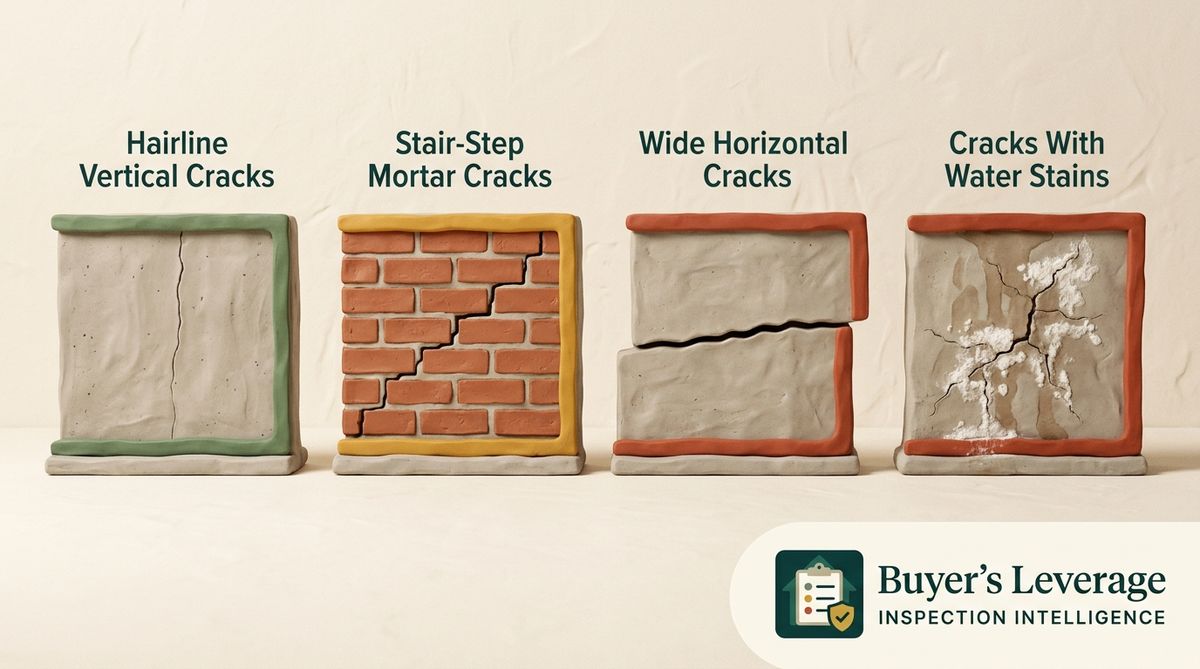
You just opened your inspection report and saw 'foundation cracks' flagged. Your heart sank. Here's the truth: most foundation cracks are cosmetic shrinkage from concrete curing, not structural failures waiting to happen.
Why Foundation Cracks Show Up in Nearly Every Inspection
Concrete shrinks as it cures. That's not a defect — it's physics. A typical residential foundation loses about 0.05% of its volume in the first few months after pouring, and that contraction creates hairline cracks.
Your inspector isn't required to ignore them, so they document what's there. That documentation protects you and the inspector. It doesn't mean your foundation is failing.
Most homes built after 1950 with poured-concrete foundations will have at least a few vertical hairline cracks. Older homes with concrete block or stone foundations show different patterns — often step cracks along mortar joints. Neither is automatically a red flag.
The Three Crack Characteristics That Actually Matter
Inspectors look at three things: width, direction, and displacement. Width is the easiest to measure — use a credit card (about 1/32 inch thick) or a dime (about 1/16 inch). Direction tells you whether the crack formed from shrinkage (vertical), settlement (diagonal), or lateral pressure (horizontal). Displacement means one side of the crack is offset from the other — you can feel a lip or step when you run your hand across it.
Here's the shorthand most structural engineers use: hairline vertical cracks under 1/8 inch with no displacement are low concern. Cracks between 1/8 inch and 1/4 inch deserve a second look, especially if they're horizontal or show displacement. Anything over 1/4 inch or actively growing gets an engineer's evaluation.
Context matters too. A single hairline crack in a 30-year-old basement is different from ten new cracks that weren't in last year's listing photos.
Vertical Cracks: Usually Shrinkage, Rarely Structural
Vertical cracks run straight up and down, often near windows, doors, or changes in wall height. These form when concrete shrinks during curing or when minor settling happens evenly across the foundation.
If the crack is less than 1/8 inch wide, has no offset, and isn't growing, it's almost often cosmetic. Your inspector will still note it because it's visible. That's their job.
You do want to check whether water is coming through. Even a hairline crack can let moisture seep in during heavy rain. If you see staining, efflorescence (white mineral deposits), or dampness around the crack, that's a separate issue — not structural, but worth addressing for moisture control.
Horizontal Cracks: The Ones That Deserve Immediate Attention
Horizontal cracks usually mean the wall is being pushed inward by soil pressure. This happens when soil expands (clay-heavy regions after rain) or when water isn't draining away from the foundation properly.
Even a thin horizontal crack is worth flagging. If it's wider than 1/8 inch or the wall is bowing inward, stop and call a structural engineer before you proceed. This is one of the few foundation issues where the word 'urgent' actually applies.
Repairs for bowing walls can range from installing carbon-fiber straps (around $4,000–8,000) to full wall replacement ($10,000–25,000+). You'll want that scoped before you close.
Step Cracks in Block Foundations: When Mortar Tells the Story
Concrete block foundations develop cracks along the mortar joints, creating a stair-step pattern. This happens when one part of the foundation settles more than another — common in homes built on clay soil or where drainage has changed over time.
Step cracks narrower than 1/4 inch and showing no active movement are usually stable. Your inspector may recommend monitoring them — take a photo with a coin for scale and check it again in six months.
Wider step cracks, especially with displacement or bowing, suggest ongoing settlement. A structural engineer can tell you whether it's stabilized or still moving, and whether underpinning (stabilizing the footing) is needed.
What 'Displacement' Means and Why It Changes Everything
Displacement is when one side of a crack has moved relative to the other. Run your hand across the crack — if you feel a ridge or lip, that's displacement. Even a hairline crack with displacement tells you the foundation has shifted, not just shrunk.
Small displacement (under 1/8 inch) in an old home may be ancient history — the movement happened decades ago and stopped. But if the crack looks fresh (clean edges, no paint over it) or matches exterior grading problems, that's a sign the issue is recent.
Your inspector can't tell you when the movement happened. That's where a structural engineer earns their fee.
When to Hire a Structural Engineer (and What You'll Pay)
A structural engineer's foundation evaluation typically costs $400–700 for a standard residential visit. You'll get a written report that says whether the cracks are cosmetic, stable but monitor-worthy, or actively concerning.
Call an engineer if your inspector notes any of these: horizontal cracks, step cracks wider than 1/4 inch, vertical cracks with displacement, multiple new cracks, or visible bowing or leaning in the wall. Also call if you see cracks both inside and outside in the same area — that often means the crack goes through the full thickness of the wall.
The engineer's report becomes a negotiation tool. If repairs are recommended, you can ask the seller to handle them, request a credit, or walk if the numbers don't work. The $500 you spend now can save you from a $15,000 surprise a year after closing.
How Soil Type and Drainage Affect Foundation Cracking
Clay-heavy soil expands when wet and contracts when dry. That cycle creates pressure on foundation walls — picture a slow-motion squeeze every time it rains, then a release every summer. Homes in Texas, Colorado, and parts of the Midwest see this constantly.
Poor drainage makes it worse. If gutters dump water next to the foundation, or if the yard slopes toward the house, you're funneling water right where you don't want it. That water saturates the soil, increases pressure, and finds every crack it can.
Fixing drainage is often cheaper and more effective than repairing cracks. Extending downspouts, regrading soil away from the foundation, and adding a perimeter drain can stop new cracks from forming. Your inspector should note grading and drainage issues alongside foundation findings — they're connected.
What 'Monitor and Maintain' Really Means
You'll often see inspector language like 'recommend monitoring' or 'no evidence of active movement at time of inspection.' That's not a dodge — it means the crack is there, it's stable right now, but the inspector can't predict the future.
Monitoring is simple: take a dated photo with a coin or ruler for scale, then check it every six months. If the crack widens or new cracks appear, you'll catch it early. Some people use a crack-monitoring gauge (a small plastic card that straddles the crack) — they cost about $10 and make changes obvious.
Maintenance means keeping water away from the foundation. Clean gutters twice a year, make sure downspouts extend at least four feet from the house, and check that soil slopes away from the foundation. Those three steps prevent more foundation problems than any repair product on the market.
Epoxy Injection, Sealants, and When They Actually Help
Epoxy injection fills and bonds a crack, restoring some structural strength. It's used for active cracks in poured concrete walls, especially when water intrusion is a problem. Cost typically runs $400–800 per crack for a professional job.
Sealants and hydraulic cement are surface fixes — they stop water but don't restore strength. They're appropriate for hairline cracks that aren't structural but are letting moisture through. A handyman or DIY approach can handle these for $50–150 in materials.
Neither option fixes the cause of the crack. If the crack formed because of poor drainage or soil pressure, sealing it won't stop new cracks from forming nearby. Fix the drainage first, then decide whether the crack itself needs attention.
What Foundation Cracks Mean for Your Home's Resale Value
Documented foundation cracks don't automatically hurt resale value if they've been properly addressed. A paper trail showing an engineer's evaluation, appropriate repairs, and a transferable warranty can actually reassure future buyers.
What does hurt value is deferred maintenance — visible cracks that were noted in your inspection but rarely addressed. The next buyer's inspector will flag the same issues, and now they're older and potentially worse.
If you're buying a home with foundation cracks, ask the seller for records. Was an engineer consulted? Were repairs made? Is there a warranty? If the answer is 'we just painted over them,' that tells you something about how the home has been maintained overall.
How to Think About Foundation Cracks When You're Under Contract
First, breathe. Most foundation cracks are not deal-killers. Read your inspector's narrative — they'll usually give you context about severity. If they recommend a specialist, take that seriously. If they say 'typical minor cracking,' you're likely looking at cosmetic issues.
Next, talk to your agent about whether a structural engineer makes sense for your situation. If you're in a high-water-table area, buying an older home, or seeing multiple cracks, the $500 is well spent. If it's a single hairline crack in a ten-year-old home with good drainage, you may be fine with your inspector's assessment.
Finally, remember that every home settles. The goal isn't a perfect foundation — it's a stable one that's been maintained and won't surprise you with a five-figure repair bill two years in.
Real-world scenario
You're buying a 25-year-old home in a clay-soil area, and your inspector noted three vertical hairline cracks in the basement and one diagonal step crack in a block section. Your inspector recommended a structural engineer for the step crack. You hire one for $500. The engineer's report says the step crack is old, stable, and likely from settling in the first few years after construction. No repairs needed, but the report suggests regrading the soil on the west side of the house where water pools. You negotiate a $1,200 credit with the seller to cover grading work. You close, hire a landscaper for $900, and you're done. Two years later, you snap a photo of the same cracks — no change. You sleep fine.
Foundation Crack Quick Concern Checker
Answer 5 questions about what your inspector found to see how concerned you should be.
Still in your inspection window?
Upload your report now to get a prioritized issue list, planning ranges, and negotiation talking points before your contingency expires.
- Foundation Cracks Found in InspectionProvides detailed insights on foundation cracks
- Stair-Step Cracks in FoundationExplains a specific pattern of foundation cracks
- What to Negotiate After a Home InspectionHelps buyers act on inspection findings
- Home Inspection Repair CostsOffers cost expectations for foundation repairs
- Foundation Concern CheckerTool to assess foundation crack severity
- Negotiation Letter BuilderSupports crafting repair negotiation requests
- Sample Home Inspection ReportShows example inspection report with foundation notes
Frequently asked
Are foundation cracks normal in a home inspection?+
Yes, small hairline cracks are common in most concrete foundations and usually don't signal a structural problem. Concrete shrinks as it cures, and minor settling over time is normal. Your inspector looks at crack width, location, and whether there's movement or moisture coming through.
When should I worry about foundation cracks found during inspection?+
Worry if cracks are wider than a quarter-inch, horizontal, stair-stepping through block, or showing signs of active movement like misaligned edges. Water seepage, doors that stick, or sloped floors alongside cracks also warrant a structural engineer's review before you close.
What size foundation crack is acceptable?+
Hairline cracks under 1/8 inch are usually cosmetic. Cracks between 1/8 and 1/4 inch may need monitoring or sealing. Anything over 1/4 inch typically calls for a structural engineer to assess the cause and whether repair is needed.
Should I get a structural engineer after finding foundation cracks?+
If your inspector flags cracks as a concern or recommends further review, yes. An engineer can tell you if it's cosmetic, monitor-worthy, or something that needs repair now. Most buyers make this contingent on the inspection period.
Can I negotiate foundation crack repairs with the seller?+
You can ask. Whether the seller agrees depends on the severity, local market conditions, and what your engineer or contractor estimates. Some buyers negotiate a credit, others ask for repairs before closing. Your agent can help frame the request.
How much do foundation crack repairs cost?+
Minor crack sealing might run a few hundred dollars. Epoxy or polyurethane injection for deeper cracks can be $400–$800 per crack. Structural issues requiring underpinning or drainage work can climb into the thousands. Get a contractor estimate based on your specific findings.
Do foundation cracks mean the house is unsafe to buy?+
Not automatically. Many homes have minor cracks that don't affect safety or value. The key is understanding what caused them and whether they're stable. A structural engineer can give you that answer and help you decide if you're comfortable moving forward.
What's the difference between vertical and horizontal foundation cracks?+
Vertical cracks often result from normal concrete curing or minor settling and are usually less serious. Horizontal or diagonal cracks can indicate soil pressure or structural movement and are more likely to need professional evaluation and repair.
Buyer's Leverage provides decision-support information, not legal, engineering, inspection, contractor, lender, insurance, or financial advice. Repair exposure ranges are planning estimates, not bids.