Stair-Step Cracks in Foundation: What Homebuyers Need to Know
Discover what stair step cracks in foundation mean, how to evaluate their severity, and what homebuyers should watch for in inspection reports.
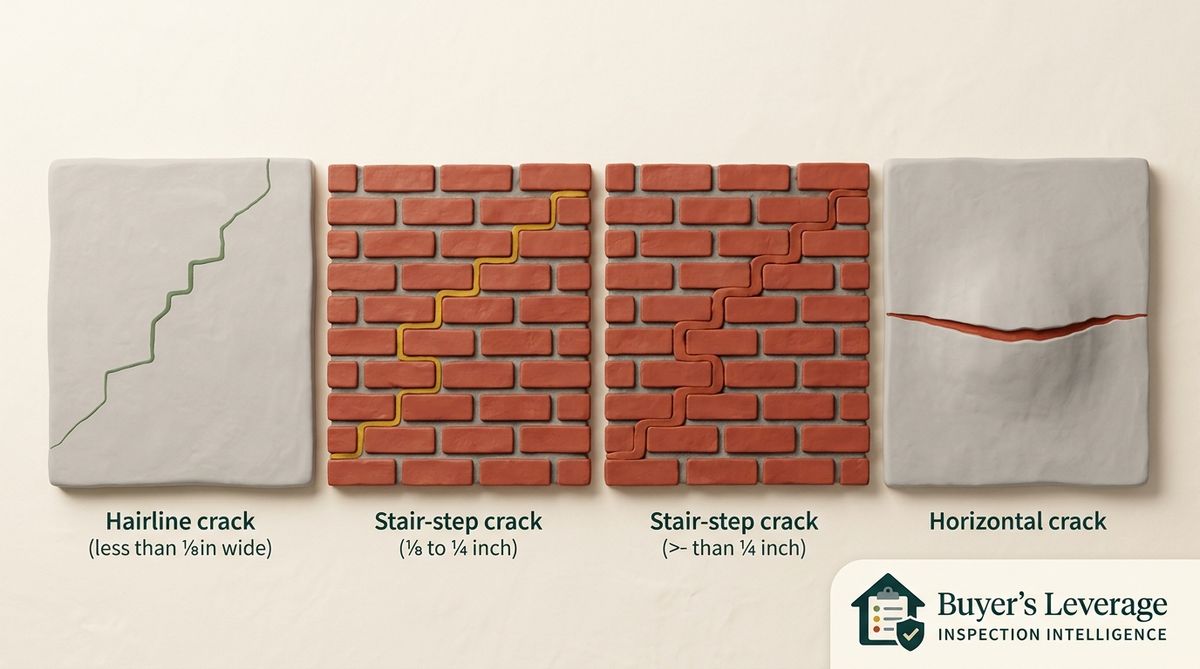
You opened your inspection report and saw 'stair-step crack in foundation.' Your stomach dropped. Take a breath — not all foundation cracks are the same, and many are routine settling that doesn't threaten the structure.
Why Foundation Cracks Follow the Stairs
Stair-step cracks run diagonally across brick or concrete-block foundations, following the mortar joints like a flight of stairs. They happen because mortar is softer than the blocks themselves — when the foundation shifts slightly, the crack takes the path of least resistance.
Settling is normal. Every house moves a little as the soil beneath it compacts, freezes, thaws, or shifts with moisture. A thin hairline crack along a few joints is often just the house adjusting to its site over the first few years.
What separates routine settling from a structural concern is how much the foundation has moved, and whether it's still moving.
What Your Inspector Is Looking For
Your inspector doesn't just note the crack — they measure it, check for displacement, and look at the surrounding context. Width is measured at the widest point, usually with a crack gauge or card.
Displacement means one side of the crack is offset from the other — the blocks don't line up anymore. Even a narrow crack can be concerning if one side has shifted in or out, up or down.
Inspectors also look at the crack's length, whether it's active (fresh mortar dust, clean edges), whether it's horizontal or diagonal, and what's happening outside near the same wall — soil grade, downspouts, settled pavement.
The Width Thresholds That Matter
Most engineers and inspectors use these rough guidelines:
Under ⅛ inch: Typically cosmetic. Monitor over time, seal to keep water out, but rarely a structural concern on its own.
⅛ inch to ¼ inch: The gray zone. If there's no displacement and the crack isn't growing, it's often still routine. If it's wider at the top, getting longer, or paired with other cracks, an engineer's opinion can clarify whether action is needed now or just monitoring.
Over ¼ inch or any displacement: This usually warrants a structural engineer's evaluation, especially if the crack is active or there are multiple stair-step patterns on the same wall.
What 'Displacement' Actually Means
Displacement is when the two sides of the crack no longer sit flush. Picture a crack running diagonally — if you run your hand across it and one block is pushed in a quarter-inch, or one side has dropped, that's displacement.
Displacement signals that the foundation has moved enough to shear the mortar and shift the masonry. That's a bigger deal than a surface crack. It often points to ongoing settlement, soil pressure from outside, or inadequate drainage that's pushing or pulling the wall.
Even narrow cracks with displacement deserve a closer look. Width isn't the only story.
When It's Just Normal Settling
Hairline stair-step cracks — under ⅛ inch, no offset, no recent growth — are extremely common in homes over five years old. Mortar is weaker than block. Soil compacts. Seasonal freeze-thaw cycles shift things a fraction of an inch.
If the crack is old (weathered edges, painted over, dusty), stable (your inspector didn't see fresh mortar dust or clean breaks), and not paired with interior cues like stuck doors or sloped floors, it's usually in the 'monitor and maintain' category.
Your inspector may still recommend sealing it to keep water out of the foundation, which is smart maintenance but not an emergency repair.
When to Bring In a Structural Engineer
A structural engineer's evaluation makes sense when:
- ·The crack is over ¼ inch wide.
- ·You see displacement — one side pushed in, out, or down.
- ·There are multiple stair-step cracks on the same wall, or cracks on multiple walls.
- ·The crack is horizontal (these are rarer but more serious).
- ·You notice interior symptoms like doors that won't close, cracks in drywall above the foundation, or floors that feel uneven.
An engineer will measure, document, sometimes dig test pits to see what's happening at the footing, and give you a written opinion on cause, severity, and repair options. Most evaluations run a few hundred dollars and take one visit.
Your agent or inspector can usually refer someone local who works with homebuyers regularly.
Common Causes Behind Stair-Step Cracks
Stair-step cracks usually trace back to one of a few things:
Settling: The soil under the footing compacts over time, especially if the home was built on fill or clay. If it's uniform and slow, you get small cracks that stabilize.
Hydrostatic pressure: Water in the soil outside pushes against the foundation. Poor grading, missing gutters, or a high water table can all load the wall and cause it to bow inward or crack.
Expansive soil: Some clays swell when wet and shrink when dry. The constant push-pull can crack block foundations over years.
Footing issues: If the footing wasn't poured deep enough or wide enough for the soil type, the foundation can settle unevenly and crack.
Understanding the cause helps frame the repair. An engineer can usually pinpoint it.
Repair Options and What They Involve
Repair approaches depend on whether the crack is cosmetic or structural, and whether the movement has stopped.
For stable cosmetic cracks: Clean out loose mortar, fill with a flexible masonry sealant or hydraulic cement, and monitor. This keeps water out and costs a few hundred dollars if you hire it out.
For active or structural cracks: Carbon-fiber straps, steel I-beams, helical piers, or underpinning may be recommended depending on what's causing the movement. These repairs typically address the root cause — stabilizing the wall or supporting the footing — not just filling the crack.
Piering and underpinning can run several thousand dollars per wall section. Straps and epoxy injection are often less. Every situation is different, which is why an engineer's scope matters before you get bids.
How This Affects Your Purchase Decision
If the crack is minor and your inspector says it's stable, you're likely looking at basic maintenance — not a deal-breaker. Get it sealed, keep gutters clean, grade soil away from the house.
If the crack is wide, displaced, or paired with other red flags, you'll want an engineer's report before you close. That report becomes the basis for deciding whether to ask the seller to repair, ask for a credit, negotiate price, or — in rare cases — walk if the repair scope is beyond what you're comfortable taking on.
Your agent will help you frame the request based on what's typical in your market. Some sellers will handle the repair before closing. Others will offer a credit or price reduction and let you manage it after you own the home.
Remember: most foundation cracks are fixable. The question is who pays and when.
What to Check Elsewhere in the House
Foundation movement often leaves clues inside and outside the house. Walk through and look for:
- ·Cracks in interior drywall, especially near corners or above door frames.
- ·Doors or windows that stick or won't latch.
- ·Gaps between baseboards and the floor.
- ·Sloped or uneven floors (a marble rolls on its own).
- ·Cracks in the garage slab or exterior patio concrete near the foundation.
Outside, check the grading — does water pool near the foundation? Are gutters missing or clogged? Is the soil settled or pulled away from the wall?
These context clues help an engineer understand whether the crack is old and stable or part of an active problem.
Monitoring vs. Repairing Right Away
Not every crack needs immediate repair. If your inspector and a structural engineer both say the crack is stable, you can monitor it over time by marking the ends with a pencil and date, or using a crack-movement gauge (a small plastic card that bridges the crack).
Check it every few months. If it grows, widens, or shows new displacement, that's your signal to act. If it stays the same for a year or two, it's likely done moving.
Monitoring makes sense for hairline cracks with no displacement in homes that are otherwise sound. It doesn't make sense if there's active water intrusion, visible bowing, or multiple warning signs.
Using Buyer's Leverage Tools to Clarify Next Steps
If you're staring at your inspection report wondering whether your stair-step crack is normal or a red flag, you're not alone. That's exactly why we built the Foundation Crack Severity Checker.
You answer a few quick questions — crack width, displacement, location, other symptoms — and the tool gives you a plain-English severity rating and suggests whether you're in monitor-and-seal territory or structural-engineer territory.
It's not a replacement for professional advice, but it's a calm starting point when you're trying to figure out your next call. You can find it in your Buyer's Leverage dashboard, or ask your agent to walk through it with you.
Real-world scenario
You're three days into your inspection period, and the report notes a stair-step crack in the basement block wall, about ⅛ inch wide, no displacement mentioned. You call your inspector and ask if it's a big deal. He says it looks old and stable, suggests sealing it to keep moisture out, and doesn't think you need an engineer unless you're seeing other issues. You walk the basement again — doors close fine, floor feels level, no new drywall cracks. You decide to ask the seller to have it sealed before closing as part of your repair requests, which they agree to do. One small ask, handled calmly, and you move forward with confidence.
Stair-Step Crack Severity Checker
Answer four quick questions to gauge how concerned you should be about stair-step foundation cracks
Have an actual inspection report?
Upload it and receive a report-specific analysis with prioritized concerns, repair exposure planning, and negotiation guidance.
- foundation cracks found in inspectionexplains different types of foundation cracks, including stair-step cracks
- what to negotiate after a home inspectionguides buyers on negotiation strategies for foundation issues
- home inspection repair costshelps estimate potential costs of repairing foundation cracks
- foundation concern checkertool to assess severity of foundation crack concerns
- repair exposure calculatorcalculates potential financial exposure to repair costs
- upload your home inspection reportupload inspection reports for personalized analysis
Frequently asked
What causes stair-step cracks in foundation walls?+
They're usually caused by settlement — the ground under one part of the foundation shifts or compresses. This can happen from soil movement, water issues draining toward the foundation, or just the house settling over time. Sometimes they're minor and stable. Sometimes they signal ongoing movement that needs a fix.
How do I know if a stair-step crack is serious?+
Width is the main clue. Cracks under ¼ inch and stable for years are often cosmetic. Anything wider than ½ inch, or cracks that go through the block and show daylight, usually need a structural engineer to look. Your inspector will flag which category yours falls into.
Can I negotiate a lower price because of foundation cracks?+
Sometimes. It depends on the severity and whether a structural engineer's already weighed in. Many buyers ask the seller to get an engineer's assessment, then use that report to frame a repair credit or price reduction. Your agent can walk you through what's common in your market.
Should I walk away from a house with stair-step cracks?+
Not automatically. Lots of older homes have minor cosmetic cracks that don't grow. But if the crack's wide, recent, or paired with sagging floors or stuck doors, it may point to active movement. Get a structural engineer's opinion before you decide anything.
How much does it cost to fix a stair-step foundation crack?+
Simple crack sealing might run $300–$800. If the wall needs stabilization with carbon-fiber straps or steel anchors, expect $3,000–$7,000 per wall. Full underpinning or helical piers can hit $10,000–$30,000+. The repair depends entirely on what's causing the crack.
Will foundation cracks get worse over time?+
Some do, some don't. Cracks caused by one-time settlement often stay stable for decades. Cracks tied to ongoing water problems, expansive soil, or poor drainage can widen. That's why inspectors and engineers look for signs of recent movement — fresh mortar dust, misaligned edges, or growing width.
Do I need a structural engineer or can my inspector handle it?+
Your home inspector flags the crack and tells you if it looks like it needs a closer look. A licensed structural engineer diagnoses the cause, says whether it's still moving, and recommends a fix. If the crack's over ½ inch or paired with other issues, get the engineer.
Can I get homeowners insurance to cover foundation crack repairs?+
Usually not. Most policies exclude damage from settling, earth movement, or long-term wear. If a sudden event like a plumbing leak caused it, you might have coverage — but slow foundation movement almost never qualifies. Check your policy or ask your agent to be sure.
Buyer's Leverage provides decision-support information, not legal, engineering, inspection, contractor, lender, insurance, or financial advice. Repair exposure ranges are planning estimates, not bids.