What to Negotiate After a Home Inspection: A Calm, Practical Framework
You just received your home inspection report. Learn what to negotiate, how to ask effectively, and when it’s time to walk away in this practical guide.
You just got your inspection report, and you're staring at 60 pages of observations. You're allowed to ask for things — that's why you have an inspection contingency. The question is what to ask for, how to ask, and when to walk away.
Your inspection contingency is a planning tool, not a weapon
The inspection contingency gives you a window — usually 7 to 10 days — to review findings and ask the seller to address issues, offer credit, or agree to let you walk. It's not adversarial by design. Most sellers expect you'll find something. They built time and budget into their plans for this.
Your job is to use the contingency to solve problems, not to re-trade the deal. That means being selective, clear, and reasonable. Ask for what matters. Skip the rest.
You're not required to ask for anything. But if you don't ask, you own the repair list the day you close. So think it through.
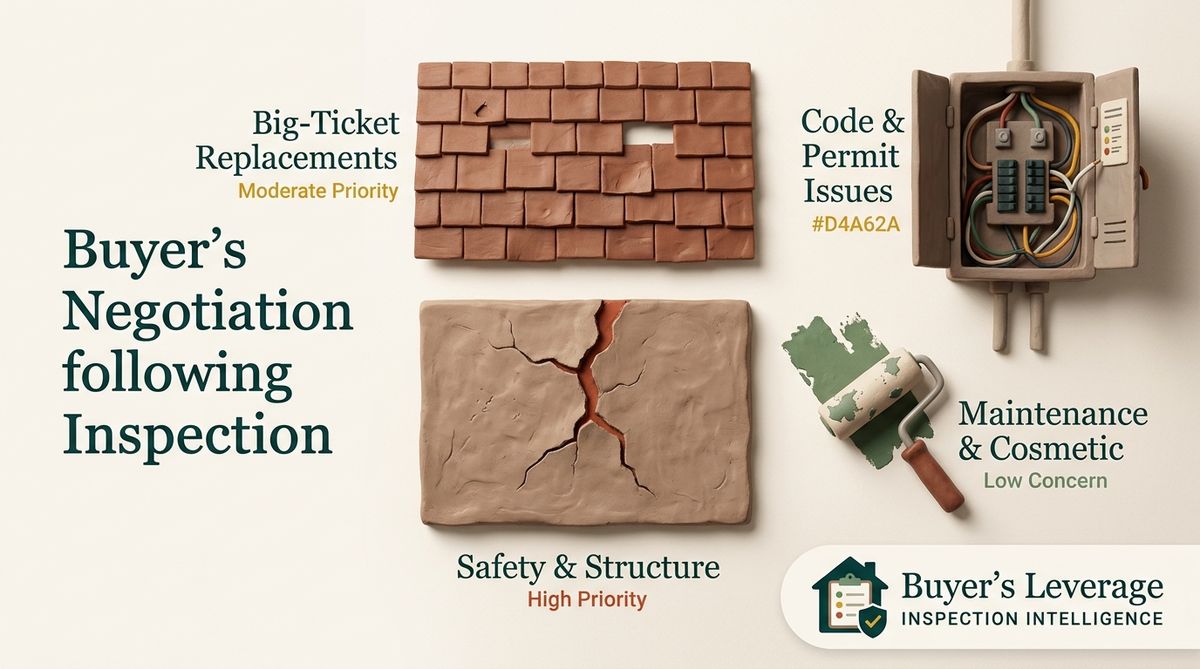
The three-bucket method: how to sort your findings
Take every item your inspector flagged and drop it into one of three buckets.
Bucket 1: Safety and health must-fix items. These are things that could hurt someone or make the home unsafe to occupy. Examples: exposed electrical wiring, active water intrusion, compromised structural supports, gas leaks, mold confirmed by testing. If it's in this bucket, you ask the seller to fix it or give you credit to fix it — no exceptions.
Bucket 2: Worth-asking repairs. These are deferred maintenance or functional issues that cost real money but aren't emergencies. Examples: a 22-year-old water heater at end of life, a roof with 3–5 years left, HVAC that works but is inefficient, grading that directs water toward the foundation. You'll ask for some of these, not all — pick the ones with the highest cost or the shortest runway.
Bucket 3: Live-with-it items. Cosmetic stuff, minor wear, and things you'd fix during a remodel anyway. Chipped paint, a loose cabinet hinge, a bedroom door that sticks. These don't make your list. Let them go.
Why credits usually win over seller-arranged repairs
You have two negotiation paths: ask the seller to complete repairs before closing, or ask for a cash credit at closing so you can handle repairs yourself after you own the home.
In most markets, credits work better. Here's why: when the seller hires a contractor, they'll pick the lowest bid and supervise the work while packing boxes. You won't get to choose the contractor, review the scope, or approve the work. You'll inherit whatever gets done — and you won't know the quality until you're living there.
With a credit, you close with cash in hand, then hire your own contractor, get multiple bids, and oversee the work. You control timing and quality. The trade-off: you'll carry the project after closing, which means you'll need to budget time and attention.
There are exceptions. If the seller is a flipper or a contractor, they may have crews on standby and offer to fix things fast and well. If the issue is small and the seller is motivated, a pre-closing fix can work. Discuss the trade-offs with your agent before you draft the request.
How to size your request without killing the deal
Here's the tension: if you ask for too much, the seller walks and you lose the home. If you ask for too little, you leave money on the table. The right request is somewhere in the middle — grounded in cost, proportional to the home price, and reasonable given the market.
Start by getting rough cost estimates for the items in Bucket 1 and the top items in Bucket 2. You don't need formal bids yet — ballpark numbers from a contractor friend or online planning ranges will do. Add them up. That's your exposure.
Now ask: is this exposure a deal-breaker? If the total is 10% of the home's value or more, you may be looking at a material defect — something that changes the value of the home. In that case, you might ask for a price reduction or walk.
If the total is 2–5% of the home price, you're in normal negotiation range. You'll ask for credit or repairs on the must-fix items and maybe the top two or three worth-asking items. Frame it as problem-solving, not punishment.
If the total is under 1%, you're likely in live-with-it territory. You can still ask, but expect pushback — and know that in a competitive market, a small ask might not be worth the friction.
Draft your response with your agent, not alone
Your agent has been through this 50 times. They know what sellers in your market typically agree to, how to frame requests, and when to push versus when to hold.
Don't write the response email yourself and hit send. Walk through your three-bucket list with your agent first. They'll help you trim the ask to what's reasonable, write the request in neutral language, and time the delivery so the seller has space to respond without feeling ambushed.
Most agents will draft the formal response for you, using standard contract language that keeps the tone professional and the request clear. Let them. This is what you're paying them for.
What a reasonable request looks like in practice
A reasonable inspection response is specific, calm, and grounded in the report. It usually includes:
- ·A short cover note thanking the seller and acknowledging that most homes have inspection findings.
- ·A list of 3–8 items you're asking the seller to address, each tied to a specific page or photo in the inspection report.
- ·A suggested remedy for each item: 'repair per a licensed contractor' or 'credit of approximately $X at closing to cover buyer-supervised repair.'
- ·A deadline for response, typically 2–3 days, giving the seller time to review with their agent.
You're not writing demands. You're opening a conversation. The seller will come back with a counteroffer — maybe they'll agree to half, or offer a flat credit, or push back on items they think are cosmetic. That's normal. You'll go back and forth, usually once or twice, until you land on something both sides can live with.
If you can't agree, you'll either exercise your contingency and walk, or you'll waive it and close anyway, owning the repairs. Most deals don't reach that point — but knowing the exit ramp exists keeps both sides honest.
When to ask for a price reduction instead of repairs
Sometimes the findings aren't small fixes — they're material defects that change what the home is worth. In those cases, asking for a few thousand dollars in repair credit doesn't solve the problem. You need a price reduction.
Examples that might support a price-reduction request: a foundation with active structural movement that'll cost $40K to stabilize. A roof that needs full replacement at $18K. An HVAC system with a cracked heat exchanger that's unsafe to operate. Knob-and-tube wiring throughout that'll cost $25K to replace. Major water damage or mold that requires remediation and drywall replacement.
If the repair total is 10% or more of the purchase price, or if the defect is something a future appraiser or buyer will flag, talk with your agent about asking for a price reduction instead of a repair credit. The seller may agree, or they may prefer to fix it themselves and keep the price. Either way, you're resetting expectations based on the true condition of the home.
Be prepared: if the seller won't budge and the issue is big enough, you may need to walk. That's what the contingency is for.
Items you should almost often ask for
Some findings show up so often that they've become standard negotiation items. If your inspector flagged any of these, it's reasonable to ask:
- ·Active water intrusion or drainage issues. Water damages homes fast. If the inspector found wet crawlspaces, standing water, or grading that slopes toward the foundation, ask the seller to fix the grading and provide proof of correction.
- ·Safety hazards with electrical or gas systems. Open junction boxes, double-tapped breakers, ungrounded outlets in wet areas, or gas appliances venting incorrectly — these are code issues and safety risks. Ask for correction by a licensed electrician or plumber.
- ·Structural movement or foundation cracks. If the inspector recommends a structural engineer follow-up, ask the seller to pay for that evaluation and address any recommendations that come out of it.
- ·Roof at end of life. If the roof has less than 2–3 years of useful life left, ask for a credit toward replacement. Most buyers don't want to take on a $15K project in year one.
- ·HVAC or water heater at end of life. Same logic — if the system is 18+ years old (for HVAC) or 12+ years old (for a water heater), ask for credit or replacement.
Items you should probably skip
Not everything in the report is worth negotiating. Inspectors are paid to document everything, so they'll call out minor issues that don't affect safety, function, or value. Asking for these makes you look inexperienced and can sour the negotiation.
Skip:
- ·Cosmetic wear and tear — scuffed walls, worn carpet, chipped paint.
- ·Minor caulking gaps or grout lines that need refreshing.
- ·Light switches or outlets that are loose but functional.
- ·Single missing roof shingles (unless there's underlying damage).
- ·Gutters that need cleaning.
- ·Landscaping or sprinkler repairs.
- ·Anything your inspector noted as 'monitor' or 'typical for age.'
If it costs less than $200 to fix and isn't a safety issue, let it go. Save your negotiating capital for what matters.
How to negotiate if the market is competitive
In a hot market where sellers have backup offers, you have less leverage. You can still ask for must-fix safety items — most sellers will agree to those because they know the next buyer will ask for the same thing. But asking for end-of-life systems or deferred maintenance might get a flat no.
If the seller pushes back hard, you'll need to decide: is the issue big enough to walk, or can you budget for it and move forward? Sometimes the answer is to ask for half of what you'd normally request, or to frame the ask as 'meet us halfway' instead of 'fix everything.'
Your agent will have a feel for what the market will bear. Trust their read, and be ready to compromise if you really want the home.
What happens after you submit your request
Once your agent sends the inspection response, the seller has a few options:
- ·Agree to everything. Rare, but it happens — especially if the findings are all safety items or if the seller is motivated to close fast.
- ·Agree to some items and decline others. This is the most common outcome. The seller will counter with a partial agreement, offering to fix the must-fix items and maybe split the cost of one or two bigger repairs.
- ·Offer a flat credit instead of itemized repairs. Many sellers prefer to offer one lump sum — say, $3,000 at closing — and let you handle all repairs yourself.
- ·Decline everything. This usually means the seller thinks your ask is unreasonable, or they have a backup offer and are willing to move on.
You'll review the seller's counter with your agent and decide whether to accept, counter back, or exercise your contingency and walk. Most negotiations resolve in 2–3 rounds. If you're stuck, your agent may suggest splitting the difference or framing a compromise.
Using Buyer's Leverage to draft a clear, reasonable request
Our [Home Inspection Negotiation Calculator](/tools/home-inspection-negotiation-calculator) helps you organize findings, estimate repair costs, and draft a request that's grounded in real numbers — not emotion. You'll upload key findings from your report, assign each to a bucket (must-fix, worth-asking, or skip), and see a planning-range estimate of total exposure.
The tool then helps you frame your request in neutral language, tying each ask to a specific inspector observation. You'll share the output with your agent, who can refine the tone and timing before sending.
It's decision-support, not a replacement for your agent's judgment. But it gives you a structured way to think through what to ask for, what to skip, and how to size the request so you protect yourself without killing the deal.
Try the calculator once you've had a chance to read through your full report and talk with your inspector about any items that need clarification. Then sit down with your agent and build the ask together.
Real-world scenario
You just got your inspection report on a 1980s split-level. The inspector flagged an HVAC system that's 19 years old, a water heater at 13 years, some grading issues near the foundation, and a handful of cosmetic items. You sit down with your agent and sort the findings into buckets. The HVAC and water heater go into 'worth asking' — both are at end of life, and replacing them will cost around $8K combined. The grading issue goes into 'must-fix' because it's directing water toward the foundation. The cosmetic stuff gets skipped. Your agent drafts a response asking the seller for a $9K credit at closing to cover those three items. The seller counters with $6K. You accept — it's enough to replace the water heater now and budget toward the HVAC over the next year. You close knowing what you're walking into.
Inspection Item Negotiation Priority Checker
See how your inspection finding stacks up as a negotiation point in three quick questions.
Still in your inspection window?
Upload your report now to get a prioritized issue list, planning ranges, and negotiation talking points before your contingency expires.
- Home Inspection Repair Costshelps buyers understand repair cost expectations
- Your Inspection Contingency Windowguides timing for negotiations after inspection
- HVAC Issues Home Inspectiondetails what buyers can negotiate regarding HVAC
- Repair Exposure Calculatortool to estimate overall repair cost risk
- Negotiation Letter Builderhelps draft effective negotiation requests after inspection
- Roof Issues Flagged in an Inspectionexplains common roof problems to negotiate
- Foundation Cracks Found in Inspectioncovers foundation concerns buyers should consider
- Sample Home Inspection Reportexample report for better understanding of inspection findings
Frequently asked
What should I negotiate after a home inspection?+
Focus on safety issues (electrical, structural, water intrusion), big-ticket items that affect the home's usability (failing HVAC, roof at end of life), and anything your inspector flagged as needing immediate attention. Your agent can help you sort findings into 'safety/function' versus 'cosmetic' — that distinction usually guides what makes sense to ask for.
Can I ask the seller to fix everything in the inspection report?+
You can ask, but it's rarely the most effective approach. Sellers typically respond better to focused requests around safety and major systems. A long list of minor items can feel adversarial and may get declined outright. Work with your agent to prioritize what really matters.
Should I ask for repairs or a credit at closing?+
It depends on the issue and the market. Credits give you control over who does the work and when. Repairs done before closing mean it's handled, but you don't choose the contractor. Talk through both options with your agent based on what the seller's likely to accept.
How much can I negotiate off the price after an inspection?+
There's no standard amount. It depends on what was found, what comparable homes are selling for, how motivated the seller is, and what your contract allows. Your agent will help you frame a request that's fair and supported by the findings.
What if the seller refuses to negotiate after the inspection?+
You'll typically have the option to move forward as-is, continue negotiating, or walk away if your contract includes an inspection contingency. Your agent can help you weigh your options based on the findings and how much you're willing to take on.
Do I need to get contractor quotes before negotiating?+
Not often, but it can help. If your inspector flagged something major — like a roof replacement or foundation work — a ballpark estimate gives you and the seller real numbers to work from. For smaller items, rough planning ranges are often enough.
Can I negotiate after the inspection if I waived the inspection contingency?+
You can still ask, but you've given up your contractual right to walk away or demand repairs based on what's found. Some sellers will still work with you in good faith, but they're not obligated to. It's a much weaker negotiating position.
How long do I have to respond after receiving the inspection report?+
It's spelled out in your purchase contract — often between 3 and 10 days depending on your state and what you negotiated. Check your contract or ask your agent. The clock usually starts the day the inspection happens or the day you receive the report.
Buyer's Leverage provides decision-support information, not legal, engineering, inspection, contractor, lender, insurance, or financial advice. Repair exposure ranges are planning estimates, not bids.