Roof Issues Home Inspection: What Your Inspector Is Really Telling You
Learn what roof issues flagged in your home inspection truly mean and when they require action or negotiation.
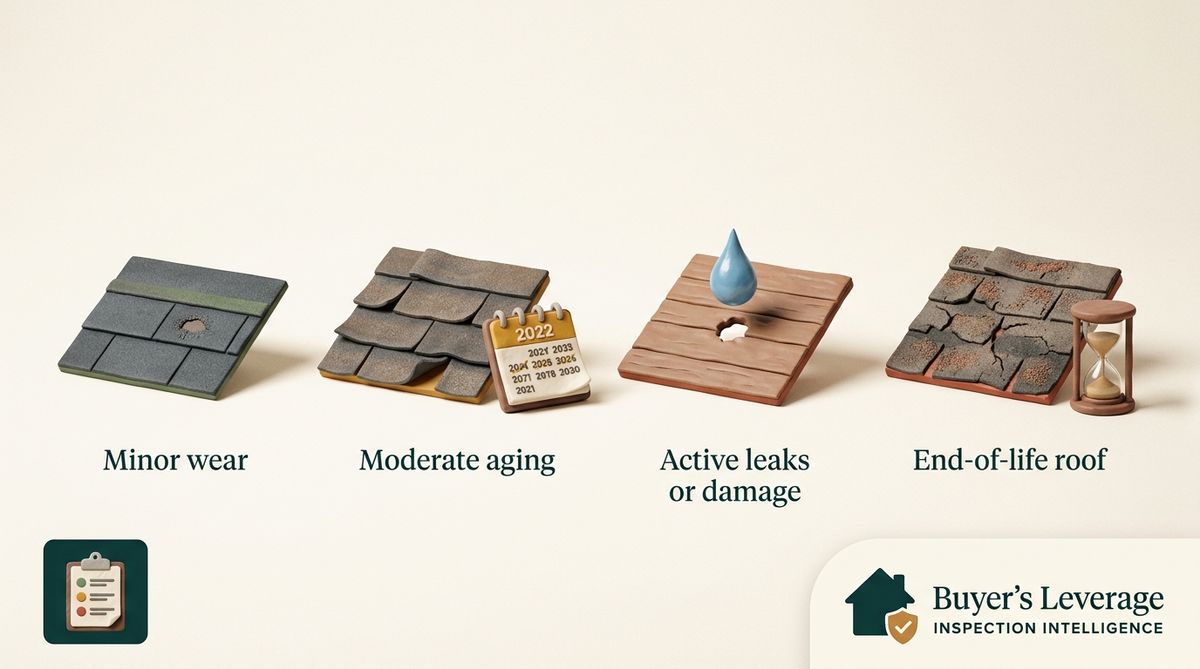
Your inspector flags the roof on page one, and suddenly you're Googling 'new roof cost' at midnight. Before you panic or ask the seller for $20,000, let's walk through what roof findings actually mean and when they matter.
How Inspectors Evaluate Roofs (and Why It Feels Vague)
Your inspector walked the roof (or used binoculars from the ground if it wasn't safe to climb). They're looking at shingle condition, flashing integrity, valleys, penetrations like vents and chimneys, and any signs of active leaks or past repairs.
Here's the tricky part: most inspectors aren't roofers. They're trained generalists. They'll note visible wear, estimate age based on material type and condition, and flag anything that looks like it needs attention. But they rarely commit to 'this roof has exactly 4.2 years left.'
That's not evasion — it's honest. Roof lifespan depends on installation quality, ventilation, weather exposure, maintenance, and a dozen other variables. What you're getting is a snapshot of condition on inspection day, not a warranty.
Your job now is to translate those findings into action. Some are plan-ahead items. Some are negotiate-now issues. Let's sort them out.
Roof Age and Expected Lifespan by Material
The first thing to check: what kind of roof is it, and how old?
3-tab asphalt shingles: The economy option. Expected lifespan is about 20 years, sometimes less in harsh sun or hail-prone areas. If your inspector notes a 3-tab roof that's 18 years old, you're near the end of useful life.
Architectural (dimensional) shingles: Thicker, more durable. Typical lifespan is 25-30 years. A 15-year-old architectural roof still has meaningful life left, assuming it was installed well and shows normal wear.
Tile (clay or concrete): Can last 50+ years if maintained. Issues here are usually broken tiles or underlayment failure, not the tile itself.
Metal roofing: 40-70 years depending on material (steel, aluminum, copper). Fastener rust and panel seam integrity are the watch points.
Knowing the material and install date (ask the seller, check permits, or have your inspector estimate from condition) gives you the framing for every other finding.
Granule Loss: What It Means and When to Worry
If your inspector notes 'moderate granule loss' or you see photos of gritty residue in the gutters, that's a later-life signal for asphalt shingles. Granules protect the asphalt mat from UV damage. Losing them accelerates aging.
Some granule loss is normal, especially in the first year (manufacturing excess) and the last few years of a roof's life. The question is degree and location.
Light, even granule loss on a 12-year-old roof: normal wear. Keep an eye on it.
Heavy loss on southern or western slopes, bare spots visible: that roof is in its final chapter. Plan for replacement within a few years.
Bald patches or exposed asphalt mat: that's end-of-life. The mat itself will start to crack and leak.
If granule loss is concentrated and the roof is otherwise middle-aged, a roofer can sometimes extend life with targeted repairs or coatings. But if it's widespread, you're looking at replacement planning.
Curling, Cupping, and Lifted Shingles
Shingles curl or cup when the asphalt mat dries out and loses flexibility. Edges lift, corners peel up. Wind can get under them, water can wick underneath, and suddenly a 'cosmetic' issue becomes a leak risk.
Curling happens faster on roofs with poor attic ventilation — heat builds up, bakes the shingles from below. It also happens on older roofs that have just reached the end of their pliable years.
If your inspector flags curling and the roof is past 75% of its expected lifespan (say, a 17-year-old 3-tab roof), that's a 'plan for replacement soon' finding. If the roof is younger, ask about attic ventilation — improving airflow can slow the damage and extend life.
Lifted shingles are often fixable with adhesive or nails if caught early. But if the inspector notes widespread lifting, that's a wind-vulnerability and leak-risk issue worth discussing with a roofer.
Flashing Issues Around Chimneys, Vents, and Skylights
Flashing is the metal or rubber seal around roof penetrations — chimneys, vent pipes, skylights, valleys. It's the #1 place roofs leak, and it's also one of the most fixable findings.
Your inspector might note 'loose chimney flashing,' 'gaps at pipe boots,' or 'missing step flashing at sidewall.' These aren't roof-replacement issues. They're repair-and-reseal issues. A good roofer can address most flashing problems in a few hours.
That said, if the flashing has been leaking for a while, you may see staining on the chimney interior, water marks in the attic, or soft decking nearby. That's when a flashing fix becomes a flashing-plus-decking-repair project.
Flashing issues are common, especially on older roofs or homes with aftermarket skylights. They're worth fixing before you move in, and they're reasonable negotiation points — but frame them as discrete repairs, not reasons to replace the whole roof.
Valley Wear and Why It Matters
Valleys are where two roof planes meet. Water funnels down valleys at high volume, so they wear faster than flat sections. Inspectors often call out valley wear because it's a leak-prone spot.
You might see notes like 'worn valley shingles,' 'exposed valley metal,' or 'granule loss concentrated in valleys.' If the valley metal (often aluminum or galvanized steel) is visible and corroded, that's a higher-priority repair.
If the valley looks worn but intact and the roof is middle-aged, you're probably fine for a few more years. If the valley shows active rust, gaps, or previous patch jobs, get a roofer's opinion before closing.
Valley repairs can sometimes be done without a full roof replacement — a roofer can re-shingle the valley section and install new underlayment. Cost and feasibility depend on how the original valley was built (open metal, woven, closed-cut).
Soft or Spongy Decking: The Hidden Concern
If your inspector walked the roof and noted 'soft spots near the chimney' or 'spongy decking at the ridge,' that's a red flag. The roof decking — usually plywood or OSB sheathing under the shingles — should feel solid underfoot.
Soft decking means water has been getting in. It could be from an old leak that's since been patched, or it could be ongoing. Either way, compromised decking affects structural integrity and has to be replaced before you can re-roof that section.
If the soft spot is small and localized (near a known leak source like a chimney), it's usually a contained repair — cut out the bad section, sister in new sheathing, reflash, re-shingle. If the inspector notes multiple soft areas or widespread sponginess, you're looking at a bigger decking replacement project.
This is a 'get a roofer out before you negotiate' finding. The decking itself is hidden under shingles, so inspection photos won't tell the full story. A roofer can pull a few shingles, inspect the sheathing, and give you a real scope.
Active Leaks vs. Past Leaks vs. Potential Leaks
Inspectors distinguish between current leaks, evidence of old leaks, and conditions that increase leak risk. The language matters.
'Active leak at chimney flashing': water is coming in now. You'll see wet decking, damp insulation, or fresh staining. This needs immediate repair.
'Evidence of past leak, appears inactive': the inspector sees old water stains in the attic, but the wood is dry and there's no fresh damage. Someone may have fixed it, or the leak may be seasonal (ice dam, wind-driven rain). Ask the seller when it was repaired and whether they have documentation.
'Worn flashing, potential for leaks': the inspector sees a vulnerability but no current leak. This is a 'fix it soon' item, not an emergency.
If the report notes past leaks, ask your inspector whether the decking and framing look sound or whether there's rot or structural concern. Past leaks that were caught early and dried out are less worrisome than past leaks that sat and rotted framing.
When a Separate Roofer Evaluation Is Worth It
Your home inspector gives you the lay of the land. A roofer gives you a bid and a lifespan opinion. If your inspector flags anything beyond minor wear, consider bringing in a licensed roofer before you frame your repair request.
A roofer evaluation is especially useful when:
- ·The roof is near the end of expected lifespan and you're trying to figure out whether it's 'two years left' or 'eight years left.'
- ·There's soft decking, widespread granule loss, or valley concerns — things where scope and cost vary.
- ·You're considering asking the seller for a credit or replacement, and you want a ballpark number that makes sense.
- ·The inspector noted multiple issues and you're not sure which are urgent and which are cosmetic.
Most roofers will do a pre-purchase evaluation for a modest service-call fee (sometimes waived if you end up hiring them post-close). They'll walk the roof, check attic ventilation, look at flashing and valleys, and tell you what they'd do and roughly what it costs.
That's the information you and your agent need to have a grounded negotiation conversation.
How to Frame Roof Issues in Your Repair Request
If the roof is near end-of-life or has active leaks, it's reasonable to ask the seller to address it. How you ask matters.
If the roof is 22 years old and showing heavy wear, you're not asking the seller to 'fix' it — you're negotiating who bears the cost of replacement. One common approach is to request a closing credit (a dollar amount off the purchase price) that you can put toward a new roof after closing. That way you pick the roofer and the materials.
If the issues are discrete (flashing repair, replace a few damaged shingles, reseal a valley), you can ask the seller to make those repairs before closing, ideally with documentation from a licensed roofer.
Your agent will help you calibrate. In a competitive market, asking for a $15,000 roof replacement on a house priced fairly may not fly. In a buyer-friendly market, a credit or seller-paid repair is more common.
The key is to frame your request around inspection findings and roofer input, not gut feeling. 'The roof is old and ugly' is weak. 'The roof is 23 years old, inspector noted extensive granule loss and curling, and a roofer estimated 2-3 years remaining life' is grounded.
Understanding Roof Repair and Replacement Cost Drivers
Roof costs vary wildly by region, material, pitch (steepness), number of penetrations, and whether you're repairing or replacing. Here's what drives the numbers.
Repair costs: flashing reseal ($200-$600), replace a section of shingles ($300-$1,000), fix soft decking in one area ($500-$1,500). Small stuff. If the scope grows — multiple valleys, widespread flashing issues, significant decking replacement — you're into several thousand.
Replacement costs: for asphalt shingles on a typical single-family home (1,500-2,500 square feet of roof surface), you're looking at roughly $8,000-$18,000 depending on location, shingle quality, and complexity. Tile and metal are significantly more. Steep roofs or multi-story homes add labor cost.
These are planning ranges, not quotes. Local labor rates, material availability, and your specific roof configuration all affect the final number. Use them to frame conversations with your agent, not as negotiation demands.
Buyer's Leverage has a [roof repair cost calculator](/tools/roof-repair-cost-calculator) that can give you a rough range based on your specifics — it's a starting point for understanding scope, not a contractor bid.
What to Check in the Attic While You're Thinking About the Roof
The attic tells the other half of the roof story. Your inspector probably checked it, but if you're back for a second look or a roofer visit, here's what to notice.
Ventilation: look for soffit vents (under the eaves) and ridge vents or gable vents at the top. Good airflow keeps the roof cooler and extends shingle life. If the attic is stuffy and super-hot, poor ventilation may be accelerating roof aging.
Water stains: check the underside of the roof decking for dark stains, especially around chimneys, valleys, and penetrations. Old stains that are dry and dusty are less concerning than fresh wet spots.
Insulation condition: if the insulation is compressed, wet, or moldy near a known leak area, it should be replaced when the roof issue is fixed.
Daylight through the roof: if you see pinpricks of light coming through, that's a sign of small gaps or holes. Not often urgent, but worth noting.
A roofer who inspects the attic and the roof surface together will give you a more complete picture than either view alone.
Real-world scenario
You're under contract on a 1980s ranch. The inspector notes the roof is about 19 years old (3-tab shingles), shows moderate granule loss, and has curling on the south-facing slope. He estimates 'limited remaining serviceable life.' You're not sure if that means one year or five. You call a local roofer for a $150 evaluation. The roofer agrees — the roof is late-stage, probably two to three years left, and quotes $11,500 for replacement. You and your agent decide to ask the seller for a $10,000 closing credit. The seller counters at $7,500. You accept, knowing you've got a clear scope and a roofer lined up for next summer. You move in, budget accordingly, and replace the roof on your timeline with your preferred materials.
Roof Concern Quick-Check
See how urgent your inspector's roof findings may be — in under 60 seconds.
Still in your inspection window?
Upload your report now to get a prioritized issue list, planning ranges, and negotiation talking points before your contingency expires.
- Roof Issues Flagged in an InspectionProvides detailed context on common roof inspection findings
- What to Negotiate After a Home InspectionHelps buyers understand negotiation options post-inspection
- Home Inspection Repair CostsOffers cost estimates to anticipate roof repairs expenses
- Repair Exposure CalculatorAssists in quantifying potential repair costs including roofs
- Roof Concern AssessorInteractive tool to evaluate specific roof condition risks
- Your Inspection Contingency WindowGuidance on timing decisions during the inspection period
- Sample Home Inspection ReportExample report helps buyers interpret roof inspection notes
Frequently asked
What roof issues home inspection typically finds?+
Inspectors look for missing or damaged shingles, signs of water intrusion in the attic, worn flashing around chimneys and vents, and age-related wear. They'll note soft spots, moss or algae growth, and poor drainage. Most homes have a few minor issues — it's the pattern and severity that matter.
How do I know if roof problems found during inspection are serious?+
Active leaks, structural sagging, widespread shingle loss, or rot in the decking are serious. Minor granule loss, a few cracked shingles, or cosmetic staining are usually manageable. Your inspector will flag safety or water-intrusion risks clearly. When in doubt, ask your agent about a roofer's second opinion.
Can I negotiate after a roof issues home inspection?+
Yes, if the issues are material. Buyers often ask for a repair credit, a price reduction, or that the seller fix it before closing. Your agent will help you decide what's reasonable based on the roof's condition, age, and local market. Document everything with photos and estimates.
Should I walk away if the inspection finds roof damage?+
Not necessarily. It depends on the cost to fix, the home's price, and your budget. A roof near the end of its life might mean a $10K–$20K expense, but you can often negotiate. Walk away if the seller won't work with you and the numbers don't make sense.
How much does it cost to fix roof issues found in an inspection?+
Minor repairs like replacing a few shingles or sealing flashing might run $300–$1,500. Significant repairs or a full replacement can be $8K–$25K+ depending on size, pitch, and material. These are planning ranges — get a local roofer's estimate before you negotiate.
What if the roof passes inspection but looks old?+
An old roof that's still functional isn't a deal-breaker, but it's a future expense. Asphalt shingles last about 20–25 years. If it's near that age, budget for replacement in the next few years. Your inspector will note the approximate age and remaining useful life.
Do I need a separate roof inspection after the home inspection?+
Sometimes. If your home inspector flags concerns they can't fully assess — like hidden damage or complex flashing issues — a licensed roofer can give you a detailed evaluation and repair estimate. It's common and often worth the $200–$400 for peace of mind before you finalize your offer.
Buyer's Leverage provides decision-support information, not legal, engineering, inspection, contractor, lender, insurance, or financial advice. Repair exposure ranges are planning estimates, not bids.