Electrical Issues Home Inspection: What They Mean and What to Do Next
Your home inspector flagged electrical issues. Learn what they mean and how to handle panel concerns, old wiring, and other findings safely.
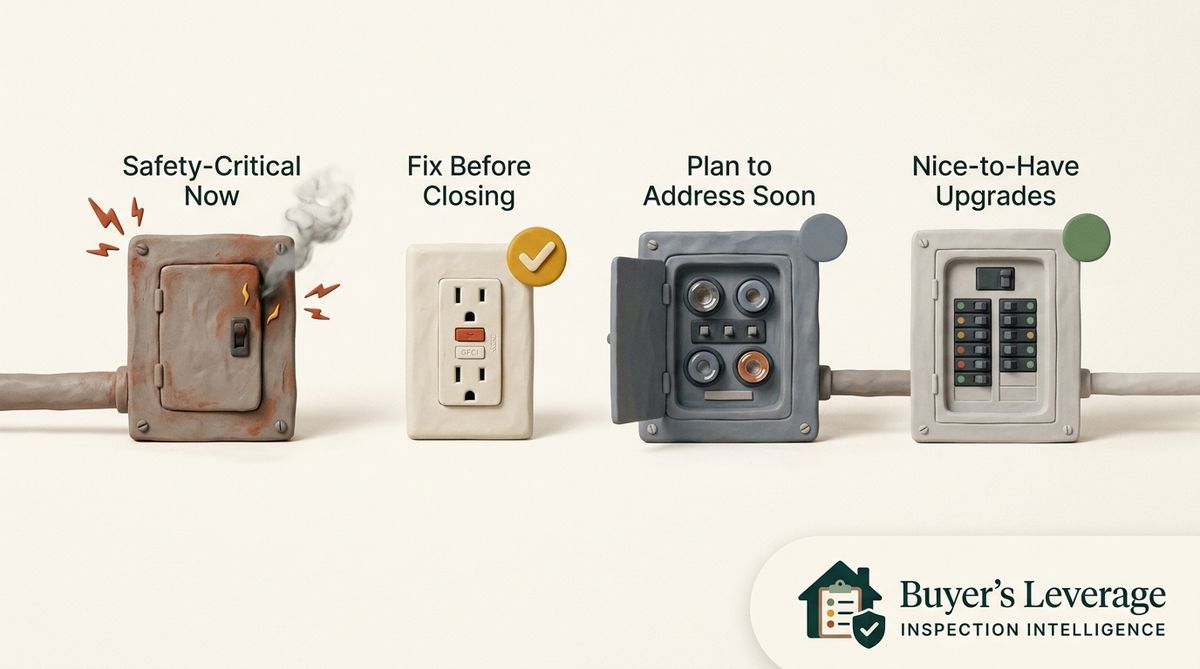
Your inspector flagged something electrical — a panel concern, old wiring, missing outlets. Most electrical findings sound scarier than they are, but a few deserve your full attention. Let's walk through what you're actually looking at.
What Inspectors Look for in Your Electrical System
Your home inspector isn't an electrician, but they're trained to spot visible red flags. They'll check the main panel, look at outlet wiring, test GFCI and AFCI protection, and note any outdated or unsafe conditions.
They can't open walls or pull wires, so they're working with what's visible. If something looks off — a warm breaker, charred wiring, an old panel brand — they'll flag it and recommend a licensed electrician take a closer look.
That recommendation doesn't mean your house is about to catch fire. It means the inspector saw something that needs a deeper evaluation than a general inspection allows. You'll see this phrase a lot: 'further evaluation by a licensed electrician.' We'll explain what that actually means in a minute.
Knob-and-Tube Wiring: The Insurance Conversation
Knob-and-tube is cloth-wrapped wiring installed before about 1950. It's not inherently dangerous if it's in good shape and hasn't been modified, but almost no homeowners insurance company will cover a house with active knob-and-tube today.
If your inspector found it, your first call is to your lender and your insurance agent. Some lenders won't close until it's fully removed. Most insurers require proof of removal or a licensed electrician's letter certifying it's been fully deactivated.
Full removal means opening walls, fishing new wiring, patching drywall — it's invasive and it's not cheap. A planning range of $8,000–$20,000+ for a whole house is common, depending on how much is still active and how accessible your walls are. Get a scope-of-work estimate from a licensed electrician before you negotiate.
Aluminum Branch-Circuit Wiring: The Pigtail Fix
From about 1965 to 1973, builders used aluminum wire for branch circuits (the wires feeding your outlets and switches). Aluminum expands and contracts more than copper, which can loosen connections over time and create fire risk.
The fix isn't rewiring the whole house — it's 'pigtailing' every connection point with a special splice connector (usually AlumiConn or COPALUM). A licensed electrician goes to every outlet, every switch, and every junction box and makes the connection safe.
Cost depends on how many connection points you have. A planning range of $2,000–$8,000 for a typical house is common. Like knob-and-tube, this is something insurers ask about, so confirm your policy will cover aluminum wiring that's been professionally retrofitted. Get documentation from your electrician.
Double-Tapped Breakers: Usually an Easy Fix
A double-tap is when two wires are connected to a single breaker that's only rated for one. It's a code violation and a potential fire hazard because the breaker may not trip properly if there's a problem with one of those circuits.
Most breakers aren't designed for two wires. The fix is straightforward: your electrician will either move one wire to an open breaker slot, install a tandem breaker (if your panel allows it), or add a subpanel if you're out of space.
This is one of the more routine findings. A licensed electrician can typically address a few double-taps in under an hour. Planning cost: $150–$400 depending on your local rates and whether a new breaker is needed.
Missing GFCI and AFCI Protection
GFCI outlets protect you from shock in wet areas — kitchens, bathrooms, garages, outdoor outlets. AFCI breakers protect against arc faults, which can cause fires. Modern code requires both in specific locations.
Older homes often don't have them, and inspectors will call it out. It's not grandfathered — if the inspector flags it, your buyer could flag it too when you sell, and some jurisdictions require upgrades when a house changes hands.
Retrofitting GFCI outlets is inexpensive — maybe $25–$50 per outlet if you're already having electrical work done. Adding AFCI breakers to your panel is a bit more, roughly $50–$150 per breaker plus labor. If your panel is very old, it may not support AFCI breakers, which brings us to the next topic.
Panel Brands That Raise Red Flags: Federal Pacific and Zinsco
Two panel manufacturers — Federal Pacific Electric (FPE) and Zinsco — are widely considered defective. FPE breakers have been shown to fail to trip during an overload, and Zinsco panels are known for breaker-bus connection failures. Both are frequently cited in fire investigations.
If your inspector noted one of these brands, you'll likely need a panel replacement. Insurers and buyers are increasingly unwilling to accept them, even if they're currently functioning.
A full panel replacement — including permits, new breakers, and labor — typically runs $2,000–$4,500 depending on your service size (100-amp, 150-amp, 200-amp) and local labor rates. This is one of the findings where 'further evaluation' really means 'get three quotes and plan for replacement.'
What 'Further Evaluation by a Licensed Electrician' Actually Means
When you see this phrase in your inspection report, it's not code for 'run away.' It means the inspector found something that needs diagnostic work beyond the scope of a general home inspection.
You'll hire a licensed electrician to come out, open the panel, test circuits, pull a few outlets if needed, and write you a report. They'll tell you what's wrong, what needs fixing, what's just old but okay, and what the code-compliant repair looks like.
This evaluation usually costs $150–$300 and takes an hour or two. You'll get a written scope of work and an estimate. That's what you bring to your agent for negotiation framing. It's normal. It's not an emergency. It's just the next step.
Reversed Polarity and Open Grounds: Common, Usually Fixable
Reversed polarity means hot and neutral wires are swapped at an outlet. An open ground means the grounding wire isn't connected. Both are safety issues, but neither is catastrophic if caught.
Your electrician will test every outlet, correct the miswiring, and confirm everything's grounded properly. If your house has older two-prong outlets and no ground wires in the walls, the fix is usually installing GFCI outlets, which provide shock protection even without a ground.
Cost is typically $100–$400 depending on how many outlets need correcting. If your whole house needs grounding upgrades, it gets more involved — but that's rare and your electrician will walk you through options.
Oversized Breakers: Why Wire Gauge Matters
If your inspector flagged an oversized breaker, it means the breaker's amp rating is too high for the wire it's protecting. A 20-amp breaker on 14-gauge wire (rated for 15 amps) won't trip before the wire overheats.
This is a straightforward fix: your electrician swaps in the correct-size breaker. It's a code violation, but it's not expensive or complicated — maybe $75–$150 per breaker.
If the problem is reversed — undersized wire feeding a high-load appliance — the fix is running new wire, which costs more. Your electrician's evaluation will clarify which scenario you're dealing with.
Service Size: When 100 Amps Isn't Enough
Many older homes have 100-amp electrical service. That was fine when houses had fewer appliances, but if you're planning to add central air, a hot tub, an electric car charger, or a big workshop, you may need a service upgrade to 200 amps.
Inspectors will note your service size but won't usually call it a defect unless the panel is overloaded or you're using extension cords as permanent wiring. Upgrading service is about future capacity, not immediate safety.
A service upgrade — new meter base, new panel, utility coordination — typically runs $2,500–$5,000. It's something to plan for, but it's not usually a deal-breaker unless you're trying to finance solar or a major addition.
DIY Wiring and Unpermitted Work: The Documentation Problem
If your inspector found evidence of unpermitted electrical work — open splices, wire nuts in exposed junctions, circuits added without permits — you've got a documentation problem as much as a safety one.
Lenders and insurers want to know that electrical work was done to code and inspected. If it wasn't, you'll need a licensed electrician to evaluate it, bring it up to code if needed, and sometimes pull permits retroactively.
This can get expensive if the DIY work is extensive. Your electrician may need to open walls to verify connections and label circuits. Budget $500–$2,000+ depending on scope, and ask your agent how to frame this in negotiation — unpermitted work is a legitimate concern.
Using the Electrical Findings to Frame Your Negotiation
Electrical findings can support negotiation — especially if they affect insurability, financing, or safety. But not every flag is a credit-worthy issue, and your agent will help you prioritize.
Knob-and-tube, aluminum wiring, and defective panels are strong negotiation points because they're blocking issues. Missing GFCI outlets and double-taps are routine and inexpensive, so sellers may agree to fix them but are less likely to offer a credit.
Get your licensed electrician's scope-of-work estimate before you negotiate. That document — not the inspection report — is what your agent will reference when framing a request. One common approach: ask the seller to complete the repairs with a licensed contractor and provide receipts and permits at closing. Another: negotiate a credit and handle it yourself post-closing. Your agent and lender will guide you.
Real-world scenario
You open your inspection report and see 'Federal Pacific Electric panel observed — recommend evaluation by licensed electrician.' You call a local electrician, and they come out two days later. They open the panel, test the breakers, and confirm what you suspected: FPE breakers are known to fail, and this one should be replaced. They give you a written estimate: $3,200 for a new 200-amp panel, installed and permitted. You forward that estimate to your agent, who frames a request: seller to replace the panel before closing, or a $3,200 credit. Seller agrees to replace it and provides the permit and receipt at closing. You move in with a new panel and documentation for your insurance company.
Electrical Safety Concern Checker
See how urgent your electrical findings are — and what to ask next.
Still in your inspection window?
Upload your report now to get a prioritized issue list, planning ranges, and negotiation talking points before your contingency expires.
- electrical issues in a home inspectionprovides detailed info on common electrical problems
- Federal Pacific electrical panelsexplains a specific electrical panel risk homebuyers should know
- Home inspection repair costshelps readers understand potential repair expenses
- What to negotiate after a home inspectionguides readers on negotiation strategies post-inspection
- Electrical panel risk tooluseful for assessing risks with electrical panels
- Repair Exposure Calculatorestimates potential costs from inspection issues
- sample home inspection reportshows example inspection report for better understanding
Frequently asked
What are the most common electrical issues found in a home inspection?+
Most inspectors flag older panels, missing GFCI outlets in wet areas, ungrounded outlets, double-tapped breakers, and outdated aluminum wiring. Many of these are code updates — the house may have been fine when it was built, but standards changed. Your inspector's report will note which issues are safety concerns versus maintenance items.
Are electrical issues a deal breaker when buying a house?+
Not usually. Most electrical flags are fixable, and many homes have at least a few. Active hazards like exposed wiring or a hot panel are rare and serious. Everything else is typically a repair or upgrade discussion. Talk with your agent about what's reasonable to address before closing.
How much do electrical repairs cost after a home inspection?+
It depends entirely on what's flagged. Replacing a few outlets might run a few hundred dollars. A full panel upgrade can be several thousand. Your inspector's notes can help a licensed electrician give you a real estimate. Buyer's Leverage provides planning ranges, not quotes.
Can I ask the seller to fix electrical problems found in the inspection?+
Yes, you can ask. Whether the seller agrees depends on your market, the contract terms, and what's flagged. Safety issues and code violations often carry more weight in negotiations. Your agent will help you frame the request and decide what's worth pushing for.
Should I get a separate electrical inspection after the home inspection?+
Sometimes. If your inspector flags something unclear or potentially serious — like old knob-and-tube wiring, a warm panel, or flickering — a licensed electrician can do a deeper evaluation. It's a small cost for clarity before you close. Your agent or inspector can recommend someone local.
What does it mean if my inspection report says the panel is 'full'?+
It means there's no room to add new circuits without an upgrade or subpanel. It's not a safety issue on its own, but it limits future electrical work. If you're planning a kitchen remodel or EV charger, mention it to an electrician so you can plan ahead.
Is aluminum wiring dangerous in an older home?+
It can be if it wasn't installed correctly or connections have loosened over time. Aluminum wiring was common in the 1960s and '70s. If your inspector flags it, have a licensed electrician evaluate whether it's safe as-is or needs remediation like pigtailing or rewiring.
What happens if I skip fixing electrical issues before closing?+
You own them. If you choose to close with known electrical issues, budget for repairs and get them handled soon — especially safety items. Some lenders or insurers may require certain fixes before funding or coverage. Check with your agent and lender first.
Buyer's Leverage provides decision-support information, not legal, engineering, inspection, contractor, lender, insurance, or financial advice. Repair exposure ranges are planning estimates, not bids.