Federal Pacific Electrical Panels: What Your Inspector Will (and Won't) Tell You
If your inspection flagged a Federal Pacific Electric panel, learn about risks, history, and next steps to make informed decisions.
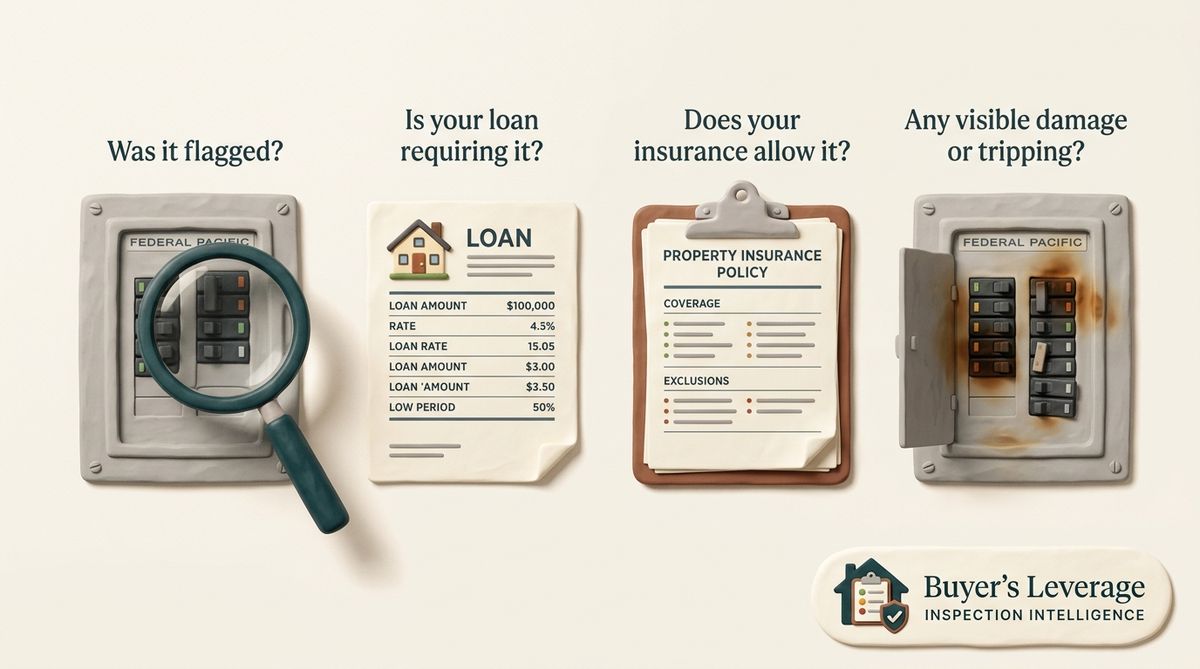
If your inspection flagged a Federal Pacific Electric (FPE) panel, you're likely wondering what comes next. This article walks you through the history, the actual risks, and how to approach the decision calmly and with context.
What Federal Pacific Electric Panels Are
Federal Pacific Electric made circuit-breaker panels (often branded 'Stab-Lok') that were widely installed in homes from the 1950s through the early 1980s. If your house was built or upgraded during that window, there's a decent chance it has one.
You'll usually see 'FPE' or 'Federal Pacific' stamped on the panel door, along with the Stab-Lok name on the individual breakers inside. The panels themselves are typically gray metal boxes, and the breakers have a distinctive red or orange test button.
These panels weren't recalled, and millions are still in service. That doesn't mean they're problem-free — it means the issue is nuanced, not black-and-white.
Why Inspectors Flag Them
Your inspector called out the FPE panel because independent testing over the years has shown that some Stab-Lok breakers don't trip reliably when they should. A breaker's job is to cut power when a circuit overheats or shorts — if it doesn't, wires can overheat and create a fire risk.
Not every FPE breaker fails, and not every panel has been problematic. But there's no way to know which breakers in your specific box will perform correctly under stress without destructive testing — which isn't practical in a home you're buying.
Inspectors flag FPE panels as a known risk item, not an automatic emergency. They're giving you information so you can follow up with a specialist and make an informed decision.
The Stab-Lok Testing History (in Plain English)
The backstory matters here. In the 1980s, independent engineers and consumer advocates tested FPE Stab-Lok breakers and found that a significant percentage failed to trip during simulated overloads. Federal Pacific disputed those findings, and no federal recall was ever issued.
Over the years, additional testing and field reports have reinforced the concern. The core issue is that some breakers may not disconnect power when a wire is overheating — which is exactly when you need them to work.
This isn't speculation or internet folklore. It's documented in engineering reports, court cases, and field experience from electricians who've worked on thousands of panels. That said, many FPE panels have been in service for decades without incident. The risk is real, but it's not likely to happen in your house tomorrow.
What 'May Not Trip' Actually Means
When we say a breaker 'may not trip,' here's what that means in practice. If a circuit draws too much current — say, from a space heater and a hair dryer running at the same time on the same circuit — the breaker is supposed to flip off and cut power.
With some FPE breakers, that doesn't happen reliably. The breaker stays on, the wire keeps heating up, and you're left with a situation where the protective device isn't protecting. That's the fire risk everyone's talking about.
The problem is unpredictable. Some breakers fail immediately. Some work fine for years. You can't know which category yours fall into without testing that destroys the breaker. So electricians and insurance companies treat all FPE panels as if they carry elevated risk.
The Insurance Question
This is often the deciding factor. Many homeowners insurance carriers — not all, but many — won't write a new policy on a house with a Federal Pacific panel. Some will insure it but require replacement within 30 or 60 days. Others will refuse to renew an existing policy once they learn about it.
Your lender will require proof of insurance before closing. If the carrier you're planning to use won't cover a home with an FPE panel, you'll need to either replace the panel before closing or find a carrier that will accept it (usually at a higher premium).
Call your insurance agent before you decide what to do. Their answer will tell you how much flexibility you actually have. If they say no, you're looking at replacement regardless of your comfort level with the panel itself.
What a Licensed Electrician Will Look For
A home inspector identifies the panel. A licensed electrician evaluates what to do about it. The electrician will open the panel cover (the inspector often doesn't), look at the breakers, check for signs of overheating or arcing, and assess the overall condition of the bus bars and wiring.
They'll also talk through your options. In most cases, the recommendation is replacement. Some electricians will replace individual breakers with modern ones if the bus bar is in good shape, but that's becoming less common — and it doesn't solve the insurance problem.
You're looking for a report that says, in plain terms, whether the panel needs replacement now, whether it's borderline, or whether it's stable enough to leave in place (rare). That report becomes the document you share with your agent, your lender, and your insurance company.
Panel Replacement: What It Involves
Replacing an electrical panel means a licensed electrician pulls a permit, removes the old panel, installs a new one (usually 100, 150, or 200 amps depending on your home's load), reconnects all the circuits, and has the work inspected by the local building authority.
The electrician will also check whether your service entrance cable and meter socket need upgrading. If your home has old aluminum wiring or other outdated components, those may need attention at the same time.
The work usually takes one to two days, and you'll be without power for several hours while the changeover happens. The electrician coordinates the power shutoff with your utility. You'll end up with a modern panel that meets current code and satisfies your insurance carrier.
Cost Drivers and Planning Ranges
Panel replacement costs vary by region, the size of the new panel, how many circuits need reconnecting, and whether the service entrance or mast needs work. In most markets, straightforward replacements run between $1,500 and $3,500. If the service entrance or meter base also needs upgrading, you might see $3,000 to $6,000 or more.
Get at least two quotes from licensed electricians. Make sure the quote includes the permit, inspection, and any utility coordination fees. Ask whether the price assumes the existing service entrance is reusable or whether that's a separate line item.
These are planning numbers, not bids. Your actual cost depends on your local market, the condition of your existing electrical system, and whether your utility requires upgrades at the meter. A written estimate from a local electrician is the only number that matters.
How This Plays Into Negotiation
Federal Pacific panels are a documented concern with a clear resolution path, which can make them easier to address in negotiation than vague or speculative issues. Many buyers ask the seller to replace the panel before closing, or request a credit to cover the cost.
Your agent can help frame the request. If your insurance carrier won't write a policy without replacement, that's a strong factual basis — it's not a preference, it's a closing condition. If the carrier will insure it but you'd rather replace it, you're asking the seller to address a known safety concern that will likely come up again when they sell to someone else.
Sellers sometimes agree to replacement, sometimes offer a partial credit, and sometimes decline. There's no likely outcome. What you're doing is giving them the choice to solve it now or risk losing the deal. Talk with your agent about what approach makes sense given the rest of your negotiation position.
If the Seller Won't Replace It
If the seller declines to replace the panel or offer a credit, you have three options. You can walk away (and your earnest money treatment depends on your contract's inspection contingency). You can negotiate a smaller credit and plan to replace the panel yourself after closing. Or you can close as-is and live with the panel, assuming your insurance carrier allows it.
Option three is the least common. Most buyers don't want to start homeownership with a known electrical issue and a potential insurance problem. If you're considering it, talk with your insurance agent first — don't assume you'll find coverage easily.
If you do replace the panel after closing, budget for it before you move in. Financing a $3,000 repair right after you've paid closing costs is tough. Some buyers roll it into their closing-cost planning or use a home-improvement loan.
Other Electrical Issues That Often Come Up Together
Homes with Federal Pacific panels were often built or upgraded during the same era when aluminum wiring and ungrounded outlets were common. Your inspector may have flagged those items too.
If your electrician is already opening the panel and doing a full replacement, ask them to look at the rest of the system. You might find that a few circuits need rewiring, or that the grounding system needs upgrading to meet current code.
Bundling those fixes into a single project can save you money and disruption. Get the full picture before you sign a contract for panel replacement alone. It's better to know the total scope upfront than to discover more work halfway through.
What Comes Next
Start by calling your insurance agent. If they say the panel needs replacement, that decision is made for you. If they'll insure it, you have more flexibility — but you'll still want a licensed electrician to evaluate the panel and give you a written recommendation.
Schedule that electrician visit as soon as you can. Inspection contingencies usually have short windows, and you'll need the electrician's report to frame your negotiation with the seller. Ask the electrician to put their recommendation in writing on company letterhead — you may need to share it with your lender or insurer.
Once you have the electrician's report and your insurance answer, sit down with your agent and talk through your options. You're not making this decision alone. Use the information you've gathered to make a calm, informed choice about what makes sense for your situation.
Real-world scenario
You open the inspection report and see 'Federal Pacific panel — recommend evaluation by licensed electrician.' You call your insurance agent first and learn they'll insure it, but at a higher premium, and they'd prefer it replaced. You schedule an electrician, who opens the panel and sees light corrosion on one bus bar. He recommends replacement and quotes $2,400 including permit and inspection. You share that quote with your agent, who asks the seller for a $2,000 credit. The seller counters at $1,200. You accept, close, and schedule the panel replacement for the week after you move in.
Federal Pacific Panel Risk Evaluator
Answer 5 quick questions to understand your panel's risk level
Still in your inspection window?
Upload your report now to get a prioritized issue list, planning ranges, and negotiation talking points before your contingency expires.
- electrical issues in a home inspectionProvides broader context on electrical problems found in inspections
- what to negotiate after a home inspectionHelps buyers leverage inspection findings in negotiations
- electrical panel risk toolAssess risks specifically associated with electrical panels
- home inspection repair costsGuides on financial planning for repair expenses
- negotiation letter builderHelps draft letters based on inspection findings
- sample homebuyer reportShows an example inspection report including electrical issues
Frequently asked
Should I walk away from a house with a Federal Pacific panel?+
Not automatically. Many FPE panels have worked for decades without incident. The issue is they fail circuit-breaker testing more often than other brands, which means higher fire risk over time. Most buyers negotiate a replacement before closing — your agent can help frame that ask.
How much does it cost to replace a Federal Pacific electrical panel?+
Most replacements run $1,500 to $3,500, depending on your home's size, the panel's location, and permit requirements in your area. That's a planning range — three contractor quotes will give you the real number. Your inspector can't quote this work.
Will my homeowner's insurance cover a Federal Pacific panel?+
Some insurers won't write new policies if you have an FPE panel, and others charge higher premiums. A few don't care. Call your insurance agent before you close — it's faster than you think and helps you plan the replacement timeline.
Can I just replace the breakers instead of the whole panel?+
No. The panel itself — the bus bars and internal connections — is the core problem, not just the breakers. Swapping in new breakers doesn't fix the underlying design issues that cause failures. A full panel replacement is the standard fix.
Is a Federal Pacific panel illegal or against code?+
No. FPE panels were legal when installed and aren't retroactively banned. But if your jurisdiction requires electrical work to meet current code when you sell or renovate, replacement may be required then. Your inspector will note if local rules apply.
How do I know if my panel is actually a Federal Pacific?+
Open the panel door and look for 'Federal Pacific', 'FPE', or 'Stab-Lok' on the label or breakers. The breakers usually have red or black switches. Your inspector will confirm the brand and model in the report — don't open the panel yourself if you're not sure.
What should I ask the seller to do about the FPE panel?+
Common options: ask the seller to replace it before closing, request a credit toward the replacement cost, or negotiate a price reduction. Your agent will help frame the ask based on your market and inspection period. There's no single right answer.
How urgent is replacing a Federal Pacific panel?+
It's not an emergency if the panel is working today — but it's a known elevated risk that should be addressed within a reasonable timeframe. Most buyers handle it before closing or within the first year. Talk with your agent and electrician about timing.
Buyer's Leverage provides decision-support information, not legal, engineering, inspection, contractor, lender, insurance, or financial advice. Repair exposure ranges are planning estimates, not bids.