Is a 20-Year-Old Furnace a Deal-Breaker? What Your Home Inspection Really Means
Is a 20-year-old furnace a deal-breaker? Understand what your home inspection really means beyond just age and make a smart buying decision.
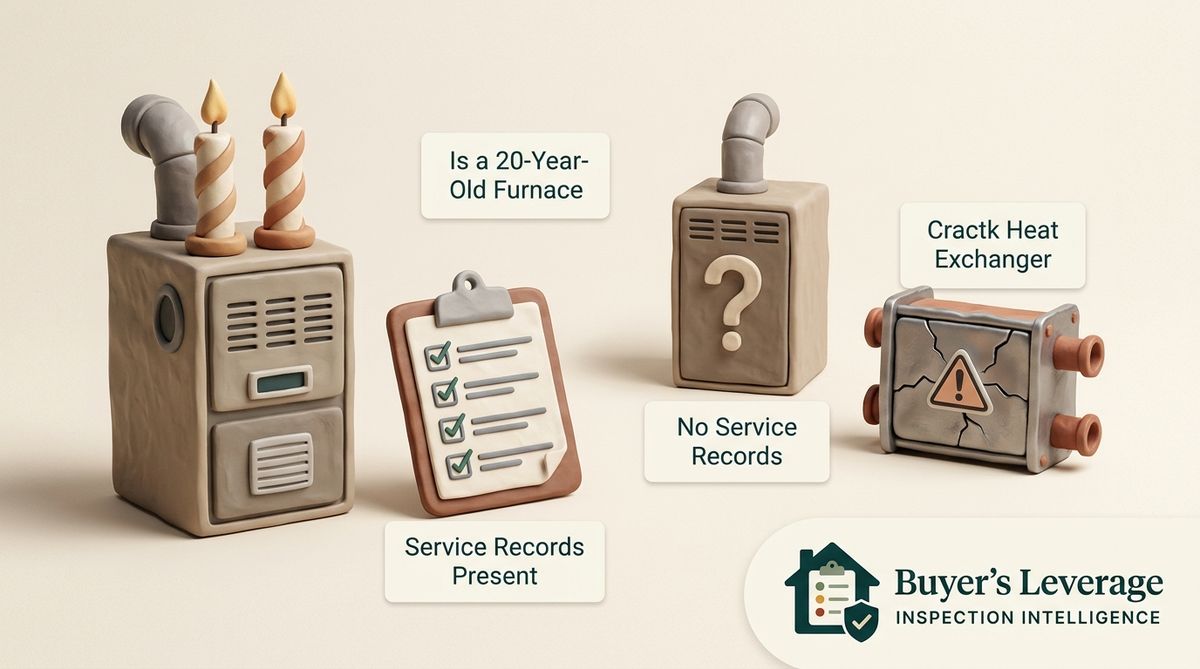
You just read 'furnace near end of useful life' in your inspection report and you're wondering if you should walk. Here's the calm truth: age is one data point, but service history, current condition, and what your inspector actually found matter more.
Why inspectors call out furnace age (and what they're really saying)
Your inspector writes 'furnace is 18 years old, near end of useful life' not because it's broken, but because national data says most furnaces last 15-20 years. It's a planning flag, not an emergency.
The phrase shows up even when the system runs fine during the inspection. Your inspector can't predict when it'll fail — they're giving you a heads-up that you're buying a home where this is an upcoming expense.
This matters because you'll own the risk the day you close. The seller won't. Your inspector is helping you plan, not telling you to run.
Gas furnaces, heat pumps, and AC: different lifespans, same aging story
Gas furnaces typically last 15-20 years. Heat pumps run closer to 10-15 because they work year-round. Central AC units land in between at 12-17 years. All three age differently, but the inspection conversation is similar.
Your report might flag one component (say, a 22-year-old furnace) while the AC is only 8 years old. That's common — systems get replaced on different schedules. Don't assume everything is equally old just because the furnace is.
If you see 'dual-fuel' or 'hybrid heat pump,' you're looking at two systems working together. Ask your inspector which part is old and which part they're actually worried about.
When age alone actually matters (even if it works fine today)
Some home insurance carriers won't cover HVAC systems over 20 years old, or they charge more. A few lenders care too, especially for certain loan types. Even if your furnace runs perfectly, you might face an underwriting issue.
Manufacturer parts availability drops off after about 15 years. A working 25-year-old furnace can become expensive to fix simply because the part you need is discontinued or requires custom fabrication.
Home warranty companies usually exclude pre-existing systems over a certain age threshold (often 15-20 years). If you were counting on a warranty to cover the first-year risk, read the age exclusions carefully.
Service history beats age every time
A 20-year-old furnace with annual tune-ups and a clean flame sensor can outlast a 12-year-old unit that's been ignored. Ask the seller for service records. Even a few years' worth tells you something.
Look for regular filter changes, burner cleanings, and seasonal check-ups by a licensed HVAC tech. If the seller has receipts showing they replaced the blower motor or heat exchanger in the last few years, that's a good sign.
No records? That's not a deal-breaker, but it shifts the risk onto you. You're making an educated guess instead of relying on data.
What your inspector actually tested (and what they didn't)
During a home inspection, your inspector turns the system on, checks airflow at a few registers, and watches the burner ignite. They look for visible rust, listen for strange noises, and check the flue and venting. It's a snapshot, not a full diagnostic.
They don't do combustion analysis, measure heat-exchanger integrity with a camera, or stress-test the system over hours. For that, you need an HVAC specialist to do a pre-purchase service call.
If your report says 'recommend HVAC specialist evaluation,' take it seriously. That's your inspector saying 'I found something I can't fully assess with my tools.'
The 'near end of useful life' phrase everyone sees
This is the single most common phrase in HVAC sections of inspection reports. It shows up on systems that are 15+ years old, even when they're working fine. It's not code for 'this will fail next winter' — it's code for 'plan for replacement within the next few years.'
Some inspectors include manufacturer date-code info and expected lifespan charts in the report. Others just write the age and move on. Either way, the message is the same: you're closer to the end than the beginning.
Don't let this phrase scare you into walking. Let it guide your next questions.
What 'recommend annual service' really means
When your report says 'recommend annual HVAC service,' that's not inspector-speak for 'this is broken.' It's literally a recommendation that you (or the seller, before closing) have a licensed tech come tune it up.
Annual service means cleaning burners, checking gas pressure, testing the igniter, inspecting the heat exchanger for cracks, and replacing filters. It costs about $100-$200 and often prevents the $800 service call six months later.
Some buyers ask the seller to complete this service before closing and provide the receipt. It's a low-dollar, high-clarity ask that can uncover hidden problems — or give you peace of mind.
When to get a second opinion from an HVAC specialist
If your furnace is over 18 years old, your inspector noted odd noises or visible rust, or you saw 'heat exchanger condition unknown,' pay for a specialist visit. It's about $150-$250 and buys you clarity.
An HVAC tech can run a combustion test, scope the heat exchanger with a camera, measure temperature rise, and tell you how many winters you realistically have left. That's worth more than guessing.
Schedule this during your inspection period. Share the findings with your agent before you decide whether to ask for a credit, a repair, or a replacement.
How age, efficiency, and operating cost connect
A 20-year-old furnace is probably 80% AFUE (Annual Fuel Utilization Efficiency) or lower. A new mid-efficiency furnace is 92-96%. That gap shows up in your heating bill, especially in cold climates.
If you're buying in Minnesota and the furnace is 22 years old, your heating costs might be 15-20% higher than if you replaced it with a 95% unit. Over a few winters, that adds up — but it's not a day-one safety issue.
Some buyers factor future efficiency savings into their negotiation. Others just plan to replace the unit in year two or three and move on.
Negotiation framing: age vs. condition vs. failure risk
Age alone usually isn't enough to demand a full replacement before closing. Sellers push back, and agents know it. But age plus evidence of poor operation, deferred maintenance, or specialist red flags may support a credit or repair request.
One common approach: ask the seller to cover an HVAC service call and provide the report. If the tech finds a cracked heat exchanger or failed igniter, you have a concrete repair to negotiate. If everything checks out, you've just bought peace of mind for $200.
Another path: request a closing credit equal to half the replacement cost, framed as 'shared risk for an aging system.' Whether that works depends on your market, your contract terms, and the seller's position. Discuss options with your agent early.
What replacement actually costs (and why it varies so much)
A mid-efficiency gas furnace replacement typically runs $3,000-$6,000 installed, depending on your region, the size of your home, and ductwork condition. High-efficiency models (95%+ AFUE) run $4,500-$8,000. Heat pumps range $5,000-$12,000.
Those are planning ranges, not bids. Your actual cost depends on whether you need new ductwork, a new thermostat, permit fees, and how accessible your existing equipment is. often get three quotes.
If your inspection report flagged the furnace age, use our HVAC Age Replacement Checker to see typical cost ranges for your region and system type. It's a starting point for the conversation with your agent — not a number to put in your repair request.
Using the HVAC Age Replacement Checker to plan your next move
After you've read your inspection report and maybe talked to an HVAC specialist, use Buyer's Leverage's HVAC Age Replacement Checker. Enter the system type, age, and your location. It'll show you typical replacement timelines and planning cost ranges.
This isn't a quote tool — it's a decision-support guide to help you and your agent frame the risk and talk through your options calmly. You'll get a clearer picture of whether this is a 'fix before closing' issue, a 'plan for year two' issue, or a non-issue.
Pair this with your inspection report analysis, and you'll walk into the negotiation informed, not anxious.
Real-world scenario
You open your inspection report and see 'furnace is 21 years old, near end of useful life, recommend HVAC evaluation.' You're buying in January in Ohio, so this matters. You call an HVAC specialist, who comes out two days later. He scopes the heat exchanger, finds a hairline crack, and says the furnace is unsafe to run. You send the report to your agent. Together, you ask the seller to replace the furnace before closing or credit you $5,000. The seller agrees to $4,000 and you close. You replace the furnace in week two of ownership with a 96% AFUE unit, pocket the extra $1,000, and sleep easier knowing your family is safe and warm.
Furnace Concern Checker
See how age, condition, and inspector notes combine to signal real concern—or routine wear.
Have an actual inspection report?
Upload it and receive a report-specific analysis with prioritized concerns, repair exposure planning, and negotiation guidance.
- HVAC Concerns in a Home InspectionProvides detailed info on HVAC and furnace-related inspection issues
- What to Negotiate After a Home InspectionGuides on negotiation strategies post-inspection findings
- Home Inspection Repair CostsHelps estimate costs for furnace replacement and other repairs
- Repair Exposure CalculatorAllows readers to calculate potential repair expenses
- Negotiation Letter BuilderSupports drafting requests for furnace repairs or concessions
- See a Sample Home Inspection ReportFamiliarizes readers with inspection report contents including furnaces
Frequently asked
How long does a furnace typically last?+
Most furnaces last 15–20 years with regular maintenance. A 20-year-old unit is at or past typical life expectancy, which means replacement could happen soon—even if it's working fine today.
Should I walk away from a house with an old furnace?+
Not necessarily. A 20-year-old furnace isn't a defect—it's a planning item. If the house otherwise fits your needs and budget, you can negotiate a credit, ask for replacement, or set aside funds yourself. Talk it through with your agent.
Can I ask the seller to replace the furnace?+
You can ask for anything during your inspection period. Sellers sometimes offer a credit instead of replacement. What works depends on your market, the home's condition, and how many other buyers are interested. Your agent can help frame the request.
What does it cost to replace a furnace?+
Replacement typically runs $3,000–$7,000 depending on your area, system size, and efficiency level. Get a couple of local HVAC quotes after you close if the seller won't address it—that gives you real numbers for planning.
Will my lender care about an old furnace?+
Most conventional lenders won't flag furnace age unless the system is actively broken or unsafe. FHA and VA loans may require it to be operational and vented properly, but age alone usually isn't a problem.
What if the furnace passes inspection but is 20 years old?+
Passing inspection means it works safely today—it doesn't predict how long it'll keep working. Budget for replacement in the next few years, and consider that timeline when you're deciding on your offer and repair requests.
How do I know if a furnace is near the end of its life?+
Your inspector will note age, condition, and any performance issues. Signs like uneven heating, frequent cycling, rust, or high utility bills can signal it's declining. Ask your inspector what they observed and whether they recommend a specialist take a closer look.
Can I negotiate a lower price instead of asking for a new furnace?+
Yes. Many buyers ask for a closing credit to cover future replacement rather than requiring the seller to install a new system. This can move negotiations along faster and lets you choose your own contractor later.
Buyer's Leverage provides decision-support information, not legal, engineering, inspection, contractor, lender, insurance, or financial advice. Repair exposure ranges are planning estimates, not bids.