HVAC Issues Home Inspection: What Buyers Should Actually Negotiate
Your inspector flagged HVAC problems. Learn what’s normal, what’s serious, and when you should negotiate to avoid costly repairs.
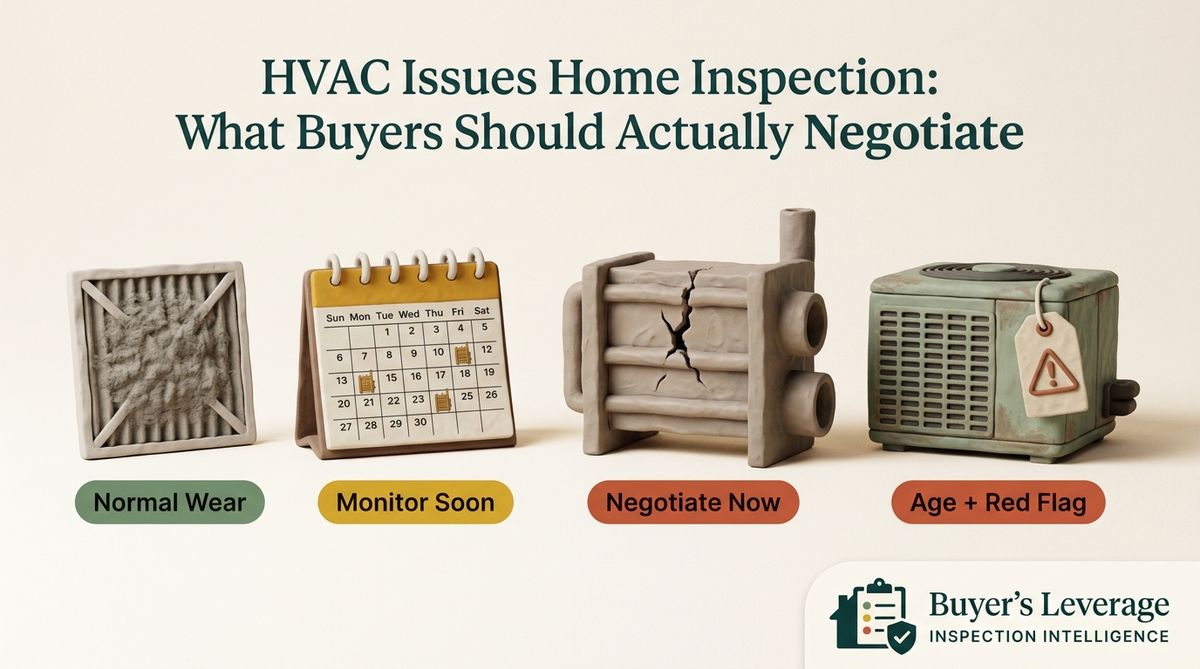
Your inspector flagged the furnace or AC, and now you're wondering if you just bought a $10,000 problem. Let's walk through what's normal wear, what's a real issue, and when age alone matters.
What Inspectors Actually Look At (and Why It Matters to You)
Your home inspector isn't an HVAC technician. They turn the system on, check airflow at registers, look at the age sticker, and note visible concerns. They won't open the unit or test refrigerant levels.
That's why reports say things like 'recommend HVAC specialist evaluation' or 'unit functional at time of inspection.' They're pointing you toward the next step, not giving you a clean bill of health.
The stuff they do flag—cracked heat exchangers, missing condensate overflow pans, rusted cabinets, disconnected ducts—those matter. So does age, especially when combined with other signs of deferred maintenance.
Furnace Age: When 15 Years Is (and Isn't) a Problem
Gas furnaces last 15 to 20 years in most climates. If yours is 12 years old and running clean, you've got runway. If it's 18 and the seller has no service records, you're planning for replacement soon.
Age alone isn't often a deal-breaker. A 16-year-old furnace with annual maintenance records and a clean flame sensor is a different animal than a 14-year-old unit that's rarely been touched.
What changes the math: visible rust inside the cabinet, yellow or flickering flames (should be steady blue), frequent cycling on and off, or odd smells when it runs. Those suggest the unit is working harder than it should. Your inspector may note these as 'recommend service' or 'near end of expected service life.'
Air Conditioner Age and the R-22 Refrigerant Question
Central AC units also last 15 to 20 years. But there's a wrinkle: if the unit uses R-22 refrigerant (common in systems installed before 2010), you're on borrowed time.
R-22 production stopped in 2020. The refrigerant still exists, but it's expensive and getting harder to find. If your 16-year-old R-22 unit springs a leak, a repair that used to cost $400 might now run $1,200 or more—and that's if a tech can source the refrigerant.
If the inspection report mentions R-22 or 'Freon' (the old brand name), check the outdoor unit's data plate or ask your inspector to confirm. Units using R-410A or other newer refrigerants don't have this issue. An R-22 system that's 12+ years old is often worth negotiating over, even if it's running fine today.
Heat Pumps: A Little Different Math
Heat pumps do double duty—heating and cooling—so they rack up more hours than a furnace or AC alone. Typical lifespan is 10 to 15 years, sometimes less in climates with harsh winters.
If your inspection found a 12-year-old heat pump, it's reasonable to budget for replacement within a few years. Heat pumps also rely on a backup heat source (usually electric resistance strips). If those aren't working, your heating bill can spike without you noticing until January.
Ask your inspector if they tested the system in both heating and cooling modes. If they couldn't (say, it was 90 degrees outside), note that in your records and consider a specialist visit before the season turns.
What 'Recommend HVAC Specialist Evaluation' Really Means
This is the most common HVAC finding, and it's not a failure. It means the inspector saw something—age, a noise, a older refrigerant type—that's outside their scope to diagnose.
It's a hand-off. You'll want an HVAC tech to run a full service check: test refrigerant charge, inspect the heat exchanger, measure airflow, check the blower motor. This usually costs $100 to $200 and takes about an hour.
If the tech finds issues, you'll have a written estimate you can bring to the negotiation table. If they say it's fine, you've got peace of mind. Either way, you're not flying blind.
Condensate Line Problems (Easier to Fix, But Tell a Story)
Your AC produces moisture as it runs. That water drains through a small PVC line, usually to a floor drain or outside. If that line clogs, water backs up—sometimes into your house.
Inspectors flag missing overflow pans, clogged lines, or lines that dump water against the foundation. These repairs are cheap—$100 to $300 in most cases—but they signal how the system's been maintained.
If the condensate line is clogged and the air filter looks like it hasn't been changed in two years, you're seeing a pattern. That's useful context when you're deciding whether to ask for a pre-closing HVAC service or a credit.
Ducting Issues: Disconnected, Crushed, or Leaking
Inspectors look in the attic, crawlspace, and basement for ductwork that's come apart, been crushed by storage, or is leaking at seams. Disconnected ducts mean you're heating or cooling spaces you don't live in.
Duct sealing and reconnection is usually straightforward—a few hundred dollars unless the whole system needs re-engineering. But if you see multiple duct issues plus an old furnace, it's worth asking if the system was ever properly balanced.
Poorly designed duct systems can shorten equipment life. Hot or cold spots in the house, uneven temperatures between floors, or rooms that rarely quite get comfortable—those are signs the ducts aren't doing their job.
Decoding Inspector Language: 'Functional at Time of Inspection'
This phrase means exactly what it says: the system turned on and produced air at the expected temperature when the inspector tested it. It does not mean the system is in good shape, properly maintained, or likely to last.
A 19-year-old furnace can be 'functional' right up until the heat exchanger cracks. That's why this language usually appears alongside a recommendation for specialist review or a note about age.
Don't read 'functional' as 'you're fine.' Read it as 'no obvious failure right now, but here's what to watch.'
When Age Alone Justifies Asking for Something
If the furnace or AC is 17+ years old, you're not being picky to bring it up in negotiation. Equipment that old has lived most of its useful life, and replacement is a question of when, not if.
Pairing age with condition helps. A 17-year-old furnace with clean service records is a different conversation than a 17-year-old furnace with rust, no maintenance history, and an inspector note recommending further review.
Your agent can help frame the ask. Common approaches: request a pre-closing HVAC tune-up and inspection by a licensed tech, ask for a credit toward future replacement, or negotiate a price reduction. What's reasonable depends on your market, the home's price point, and what else is on the list.
What an HVAC Specialist Will Tell You (That the Inspector Couldn't)
A licensed HVAC tech will test things your home inspector can't: refrigerant charge, heat exchanger integrity, blower motor amperage, thermostat calibration, and combustion efficiency. They'll also clean the coils and check electrical connections.
If the unit is old, ask the tech for a realistic remaining-life estimate and what it would cost to replace. If they find a specific problem, get a written estimate. That's the document you bring to your agent when deciding how to proceed.
Some buyers ask the seller to cover this specialist visit as part of the inspection resolution. Others pay for it themselves to keep the timeline moving. Either approach works.
When to Walk vs. When to Negotiate
If the HVAC system is shot—say, a cracked heat exchanger in the furnace or a compressor failure in the AC—and the seller won't address it, you're looking at $4,000 to $12,000 in near-term costs. That's a legitimate reason to rethink the deal, especially if you're already stretching your budget.
But most HVAC findings live in the grey zone: older equipment that's still running, minor duct issues, R-22 units that work fine today but carry future risk. These are negotiable, not deal-breakers. Your agent and your own comfort level drive that call.
If you're handy and have cash reserves, an aging HVAC system might not faze you. If you're buying at the top of your budget and can't handle a surprise $8,000 expense in year two, it's worth pushing harder or asking for a credit.
Using Buyer's Leverage Tools to Plan Your Next Step
Buyer's Leverage has a simple HVAC age and replacement checker that helps you see where your equipment falls in its expected lifespan. Plug in the installation year (check the data plate on the unit or your inspection report) and you'll get a planning-range sense of remaining life.
If the report analysis shows multiple HVAC flags—age plus maintenance issues plus duct problems—it's easier to frame your ask as a pattern of deferred upkeep rather than nitpicking one item. That's a clearer, calmer conversation with the seller.
The platform won't tell you what to demand, but it will help you organize your findings and understand which issues tend to carry weight in negotiations.
Real-world scenario
You're under contract. The inspection flags a 17-year-old furnace and a 16-year-old AC that uses R-22 refrigerant. Both units ran fine during the inspection, but the report says 'recommend HVAC specialist evaluation.' You hire a local tech who confirms the furnace heat exchanger is intact and the AC is holding refrigerant, but notes that given the age and refrigerant type, you're likely looking at replacement in the next two to four years. You take that write-up to your agent, who frames a request: seller provides a $4,000 credit at closing toward future HVAC replacement, or agrees to a pre-closing service and tune-up by a licensed contractor. The seller counters with a $2,500 credit. You accept, knowing you've got some runway and a clearer picture of what's coming.
HVAC Concern Severity Checker
See whether your inspection findings warrant negotiation or just routine service
Have an actual inspection report?
Upload it and receive a report-specific analysis with prioritized concerns, repair exposure planning, and negotiation guidance.
- HVAC concerns in a home inspectionprovides detailed info on HVAC inspection issues
- what to negotiate after a home inspectionguides buyers on negotiation strategies post-inspection
- home inspection repair costshelps estimate potential HVAC repair expenses
- Is a 20-year-old furnace a deal-breaker?addresses specific HVAC age concerns in negotiation
- Repair Exposure Calculatortool to estimate repair costs impact on budget
- Negotiation Letter Builderhelps draft effective negotiation requests
- sample home inspection reportexample to understand HVAC issues in inspection
Frequently asked
What HVAC problems found during a home inspection should I negotiate?+
Focus on safety issues (cracked heat exchangers, gas leaks), systems near the end of their expected lifespan, and units that flat-out don't work. Cosmetic stuff like dirty filters or minor rust usually isn't worth the fight. Your inspector's report will flag anything urgent.
How much does it cost to replace an HVAC system?+
A full replacement typically runs $5,000–$12,000, depending on your home's size, the equipment type, and your region. That's a planning range, not a bid. Get quotes from local HVAC contractors if replacement looks likely — costs vary a lot by market.
Can I ask the seller to replace the HVAC before closing?+
You can ask, but most sellers prefer a credit or price reduction instead of managing a contractor job before close. Talk with your agent about what's normal in your market and what leverage you have based on the system's condition.
What does 'end of useful life' mean for an HVAC system?+
It means the system is old enough that replacement is more likely than not in the next few years. Gas furnaces often last 15–20 years, AC units 12–15. An inspector flagging 'end of life' is giving you a heads-up to budget for replacement soon.
Should I walk away from a house with HVAC problems?+
Not necessarily. If the system needs replacement, factor that cost into your offer or ask for a credit. Walking makes sense if the seller won't negotiate and the repair cost pushes you over budget. Most HVAC issues are fixable or negotiable.
What's a cracked heat exchanger and is it dangerous?+
A cracked heat exchanger can leak carbon monoxide into your home. It's a safety issue and usually means furnace replacement. If your inspector flags this, take it seriously — don't operate the furnace until a licensed HVAC tech confirms it's safe or replaces the unit.
How do I know if the HVAC system was properly maintained?+
Ask the seller for service records. Clean filters, recent tune-ups, and documentation of annual maintenance are good signs. If there's no history and the system is older, budget a bit more for potential repairs — deferred maintenance adds up.
Can a home inspector tell me exactly how long the HVAC will last?+
No. Inspectors estimate remaining lifespan based on age, condition, and typical equipment longevity — but they can't predict the future. A 15-year-old furnace might run another five years or fail next winter. Plan accordingly and get a second opinion if you're unsure.
Buyer's Leverage provides decision-support information, not legal, engineering, inspection, contractor, lender, insurance, or financial advice. Repair exposure ranges are planning estimates, not bids.